You Don’t Need More Speed. You Need Fewer Restarts
You Don’t Need More Speed. You Need Fewer Restarts The modern founder’s day is a masterclass in fast motion that produces surprisingly little progress. We measure productivity in open tabs, instant replies, full...
The modern founder’s day is a masterclass in fast motion that produces surprisingly little progress. We measure productivity in open tabs, instant replies, full calendars, and the number of AI tools we can query before lunch. But the fastest founders are not the ones who cram more tools, tabs, and assistants into the day. They are the ones who protect continuity, because every scattered note, notification, and app switch forces the brain to restart work that should have stayed in motion.
The problem is not that you are moving too slowly.
The problem is that you keep having to begin again.
You sit down with a clear objective: finish the investor update, outline the product roadmap, review the hiring pipeline, draft the proposal, prepare the client strategy. Then the day starts breaking itself into pieces. A Slack message. A calendar reminder. A customer issue. A half-remembered note from yesterday. A tab you cannot find. A file that lives in the wrong system. A task that was written down somewhere, but not somewhere useful.
By 5:30 PM, you have been busy for nine hours. You have answered people quickly. You have touched dozens of tools. You have switched between roles with impressive agility: operator, manager, writer, salesperson, strategist, firefighter.
And still, the important work feels strangely unfinished.
That is the hidden tax of modern work. It is not just distraction. It is restart cost.
---
The Hidden Tax Is the Restart
When you move from one task to another, your brain does not make a clean, instant transition. It does not behave like software switching windows. It behaves more like an engine that needs time to warm up, stabilize, and reach useful speed.
If you are writing a strategic memo and stop to answer a quick message, part of your attention remains attached to the memo. If you leave a pricing model to check a customer thread, part of your working memory keeps holding the pricing assumptions. If you pause a hiring decision to look up a calendar conflict, the unresolved decision does not disappear. It follows you.
Researchers often describe this as attention residue: the mental drag left behind when your focus is forced to move before the previous task has properly closed. You may be physically looking at the next screen, but your mind is still partly processing the last one.
That is why a “two-minute interruption” rarely costs two minutes.
Imagine a founder drafting a board update on Tuesday morning. The revenue story is finally becoming clear. The opening paragraph is rough, but the structure is forming. Then a notification appears: a customer success lead needs approval on a refund for an important account.
The founder opens Slack, reads the thread, checks the account history, opens Stripe, approves the refund, replies to the team, and returns to the document. The whole detour takes four minutes.
But the memo is no longer warm.
The founder rereads the last three paragraphs. Opens the revenue dashboard again. Tries to remember the point that was about to come next. Rebuilds the narrative. Deletes a sentence. Stares at the screen.
The interruption took four minutes. The restart took fifteen.
Now multiply that by twenty or thirty tiny breaks across the day. The true cost is not the time spent inside the interruptions. It is the time spent reassembling yourself afterward.
---
Tool-Cramming Turns Smart People Into Human Routers
The default response to this chaos is to add another tool.
A better project tracker. A better notes app. A better meeting recorder. A better AI assistant. A better dashboard. A better task manager. A better automation layer to connect the better tools you added because the previous tools did not talk to each other.
Each one arrives with a promise: less friction, more speed, cleaner execution.
But many teams accidentally create the opposite. They do not build a workflow. They build a maze.
A product manager preparing a launch update may need to check engineering progress in Jira, design status in Figma, campaign timing in Notion, customer feedback in Slack, budget notes in Google Sheets, and executive comments in email. None of these actions is hard by itself. The work becomes expensive because the context is scattered.
The product manager is no longer thinking about the launch. They are routing information between systems.
The same thing happens to a lawyer preparing for a case, a teacher planning a semester, a real estate operator coordinating contractors, or a founder trying to raise a round while running the company. The work does not live in one place. It is sliced across apps, threads, files, and memory.
That fragmentation creates a subtle identity shift. You stop being the strategist and become the search function. You stop being the builder and become the connector. You stop making progress and start maintaining the conditions required to make progress.
This is why the next productivity advantage will not come from having the most tools. It will come from having the fewest unnecessary restarts.
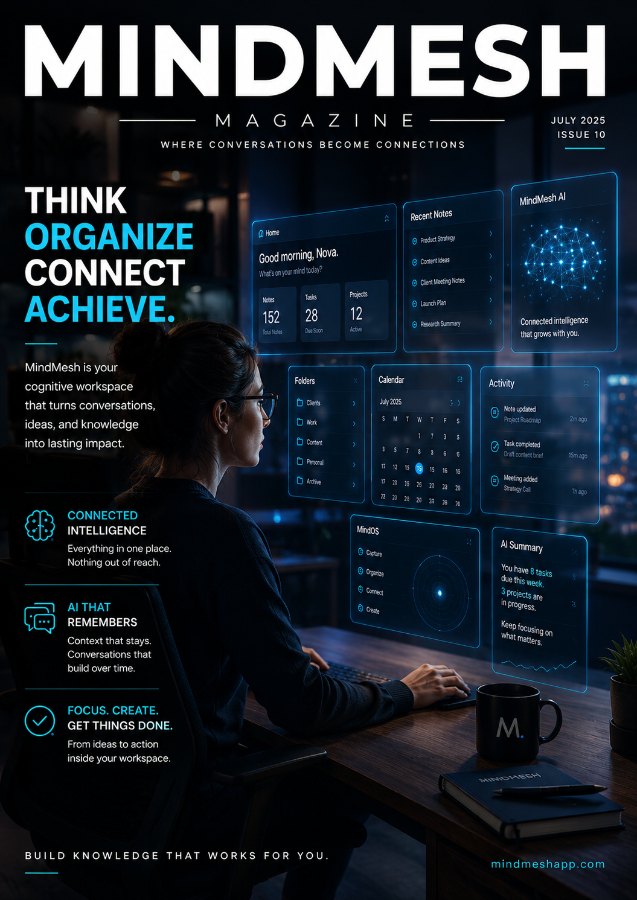
A cognitive workspace like MindMesh is built around that idea: bring notes, tasks, calendar context, and working memory into one connected environment so people can continue from where they left off instead of rebuilding the same mental setup over and over.
The goal is not to make work feel busier.
The goal is to make work stay intact.
---
The Best Work Starts Warm
There are two kinds of starts in knowledge work: cold starts and warm starts.
A cold start is what happens when you open your laptop and immediately ask:
Where was that document? What did I decide yesterday? Which thread had the client feedback? What was the next step? Why did I open this tab?
A warm start is different. The work is waiting with its context preserved. The notes are connected to the task. The task is connected to the calendar event. The decision is connected to the relevant document. The next step is visible. You do not have to reconstruct the environment before you can act.
You simply continue.
Warm starts matter because deep work is rarely created from a blank mental state. Most meaningful work depends on continuity: holding the shape of a problem long enough to improve it. A strategy becomes clear because you stay with it. A product decision becomes sharper because you keep the constraints in view. A legal argument, lesson plan, sales narrative, or design system improves because your mind remains close to the material.
This is why the best operators are often obsessive about their working environment. Not because they are neat for the sake of neatness, but because they know disorder creates re-entry cost.
A founder who ends the day by writing, “Tomorrow: finish the pricing section, use the enterprise objection from the Acme call, cut the SMB paragraph, send to Maya by noon,” has built a warm start.
A founder who simply closes the laptop and trusts tomorrow’s brain to remember everything has created a cold start.
The first founder begins the next morning inside the work.
The second founder begins by looking for the door.
---
Three Rules for a Zero-Restart Workspace
Continuity is not a personality trait. It is a design choice. You do not need perfect discipline to reduce restarts. You need a better structure for how work enters, moves, and resumes.
Here are three practical rules.
1. Capture Everything in One Trusted Place
Scattered capture is one of the fastest ways to create mental noise.
If some tasks live in Slack saved messages, some in email, some in a notebook, some in a notes app, and some in your head, your brain never fully relaxes. It knows information is leaking. So it keeps scanning the background for loose ends.
Did I reply to that person? Where did I write that idea? What was the thing I promised after the meeting? Was that in the doc or the thread?
A trusted capture system does not mean everything has to be perfectly organized the second it appears. That is not realistic. The first job is simpler: make sure nothing important stays trapped in your head or scattered across random surfaces.
When an idea, task, decision, or follow-up appears, capture it in one place fast. Then return to the work.
Your brain is better at making connections than storing fragments. Stop using it as a junk drawer.
2. Leave Breadcrumbs for Your Future Self
The most dangerous moment in work is not always the interruption itself. It is the gap between sessions.
You stop working on a proposal at 4:45 PM. You think the next step is obvious. Then the evening happens. Dinner, family, messages, sleep, morning calls. By the time you return, the project no longer feels obvious. It feels like a locked room.
Breadcrumbs unlock it.
Before you leave a meaningful work session, write a short note for your future self:
- Where you stopped - What you decided - What still feels unresolved - The exact next action - Any context you do not want to rediscover later
This takes two minutes. It can save twenty.
A consultant might write: “Next: tighten the client recommendation around cost reduction, not speed. Use the warehouse example from Thursday’s call. Need one chart showing before/after staffing.”
A teacher might write: “Next: build the discussion prompt for Chapter 5. Students struggled with the motive question. Start class with the courtroom analogy.”
A founder might write: “Next: open with churn risk, then explain onboarding fix. Do not lead with feature velocity.”
A good breadcrumb does not merely remind you what the project is. It returns you to the mental state you had when the work was alive.
3. Organize by Context, Not by App
Most people organize their work according to the tools they use. Notes go in the notes app. Tasks go in the task app. Events go in the calendar. Files go in storage. Messages stay in chat.
But your brain does not experience work that way.
Your brain thinks in contexts: the fundraising process, the launch, the client matter, the class, the renovation, the hiring plan, the quarterly strategy. When the pieces of a context live in separate tools, your brain must rebuild the whole picture every time.
A zero-restart workspace groups the work by the thing you are actually trying to accomplish.
If you are planning a product launch, the launch context should include the positioning notes, task list, calendar milestones, draft announcements, customer feedback, and open decisions. If you are preparing for a case, the case context should include the research, deadlines, client notes, exhibits, and next actions. If you are managing a hiring process, the role context should include candidates, interview notes, scorecards, follow-ups, and decision criteria.
This sounds simple because it is. But simple does not mean common.
Most people still force themselves to visit five different places to understand one piece of work. Then they wonder why they feel tired before they have done the hard part.
For more ideas on building calmer, more connected workflows, the MindMesh Magazine explores how knowledge workers can reduce context loss and design better personal operating systems.
---
AI Makes Continuity More Valuable, Not Less
AI has made output cheaper. A founder can generate draft copy in seconds. A marketer can create campaign variations quickly. A developer can ask for code suggestions. A lawyer can summarize a long document. A teacher can produce lesson ideas. A consultant can turn messy notes into a cleaner outline.
That is useful.
But it does not eliminate the need for continuity. In many cases, it increases it.
The more AI can produce, the more important it becomes to know what matters, what connects, what should be ignored, and what the real objective is. AI can help generate options, but it cannot protect your attention for you. It cannot automatically know which half-finished thought from yesterday contains the key to today’s decision unless your context is available. It cannot preserve judgment inside a workflow that keeps shattering.
The bottleneck is shifting.
It is no longer only, “How fast can we create?” It is, “How well can we stay with the right problem?”
Founders who understand this will stop optimizing their days for raw responsiveness. They will stop treating every notification as equally urgent. They will stop confusing tool adoption with operational maturity.
They will build days that protect the work long enough for it to compound.
Because the compounding happens in the continuity. It happens when the strategy stays open in your mind. When the customer pattern remains visible. When the hiring decision is connected to the company’s real constraint. When the product roadmap is not rebuilt from scratch every Monday. When the team does not waste its best thinking re-finding the same information.
Speed is not the same as acceleration. Motion is not the same as momentum. A busy day is not the same as a coherent one.
The future belongs to people who can keep the thread.
“Your best work does not need you to move faster; it needs you to stop making it start over.”