Why Your Workday Feels Full Before the Real Work Starts
Why Your Workday Feels Full Before the Real Work Starts By 5:00 PM, you have answered messages, skimmed automated summaries, cleared a few inboxes, checked three dashboards, and still avoided the work that actually...
By 5:00 PM, you have answered messages, skimmed automated summaries, cleared a few inboxes, checked three dashboards, and still avoided the work that actually matters. The day was full, but not deep. The modern workday feels overwhelming because AI has made it easier to generate, forward, summarize, and review information without protecting the quiet space where meaningful work happens. To get your life together now, you do not need more apps or more automation; you need a simpler way to gather scattered context, reduce needless re-deciding, and make the important work visible again.
This is the defining paradox of modern knowledge work. The problem is not laziness. It is not a personal failure to focus. The real issue is that our work environments have become exceptionally good at producing motion while remaining hostile to attention.
You begin the morning intending to write the proposal, finish the strategy doc, call the client, review the contract, design the lesson plan, or make progress on the project that has been sitting in your head for two weeks. Then the day starts making demands. None of them look dramatic. They arrive as quiet notifications, polite pings, calendar nudges, automated recaps, and “quick” questions.
They look like work, which is precisely why they are so dangerous.
---
The Mirage of Velocity: Why Busywork Feels Like Progress
A modern workday can feel completely full long before meaningful work begins because almost every system around you is optimized to create more artifacts. More summaries. More messages. More dashboards. More action items. More status updates. More reminders that something, somewhere, needs your attention.
On paper, this looks like velocity. In practice, it becomes a maze.
Consider Sarah, a startup founder who sits down at 9:00 AM to write a critical investor update. Before she can type the first sentence, a Slack notification alerts her to a Google Doc comment. She clicks it. The comment references a spreadsheet, which links to a Notion page, which contradicts a message in her team’s product channel.
She spends ninety minutes reconstructing the context of a single feature decision made three days ago. By the time she understands the current state of play, her creative energy is gone. She has not made progress on the investor update. She has merely survived an archaeological dig.
This is context switching dressed up as professionalism.
The problem is not that these small tasks are fake or useless. Many of them are necessary. The problem is that they arrive without boundaries, demanding that your brain stop, shift, remember, interpret, decide, and restart.
Do this twenty times before lunch and the day becomes a long series of partial arrivals. You arrive at the inbox, the project board, the meeting notes, and the spreadsheet, but you never quite arrive at the actual work.
This exhaustion is one version of AI productivity fatigue: the cognitive depletion that comes not from doing one hard thing, but from processing a hundred small pieces of work about the work. The day feels productive because your hands keep moving. It feels empty because your attention never gets to stay.
---
The Cognitive Math of the Modern Workday
For years, the promise of workplace technology was simple: automate the routine so people can focus on higher-value work. AI made that promise feel closer than ever. It can draft the email, summarize the call, extract action items, prepare the report, clean up the notes, and shorten the long thread.
But there is a fundamental difference between saving labor and saving attention.
The ActivTrak 2026 State of the Workplace signal points to a troubling pattern: AI implementation is increasing work density and administrative collaboration time while shrinking dedicated employee focus time. That confirms what many professionals already feel. Cognitive overload at work is not just a mood. It is a structural feature of how modern work is organized.
AI can make individual tasks faster while making the total workday feel heavier.
The math is simple:
- If one person can generate a polished update in thirty seconds, ten people can generate ten polished updates in five minutes. - If every meeting produces a transcript, a summary, a recap, and a list of action items, someone still has to read, verify, and decide what matters. - If every tool becomes more productive, the human sitting between those tools becomes the bottleneck.
That bottleneck is not just about time. It is about judgment.
A founder does not only need information; she needs to see the shape of the business. An operator does not only need alerts; he needs to understand which bottleneck actually matters. A lawyer does not only need a contract summary; she needs to reason through risk. A teacher does not only need lesson-plan suggestions; he needs enough mental space to think about the students in front of him.
When focus time disappears, the work does not vanish. It gets pushed into worse places: late nights, early mornings, weekend catch-up, and half-thinking during dinner. The cost is not just professional. It follows people home.
For readers tracking this broader future-of-work shift, MindMesh Magazine explores the same underlying pattern: the next productivity challenge is not whether people can produce more information. They can. The harder question is whether they can protect enough attention to turn information into decisions and meaningful action.
---
The Verification Tax: When AI Saves Labor but Steals Attention
The easiest mistake is to turn this into an argument against technology. AI is not the villain. Unmanaged noise is.
A good summary can save time. A good draft can help someone start. A good automation can remove drudgery. Used well, these tools make people feel more capable. But when every system becomes better at producing information, the receiving end becomes overwhelmed.
Humans still have to judge, connect the dots, and decide whether the output is accurate, relevant, timely, or worth acting on.
Consider Marcus, an operations director at a regional logistics firm. His team manages field reports, safety compliance logs, supply chain updates, and client change requests. Recently, they introduced an AI tool that summarizes daily site meetings. The summaries land in his inbox looking polished and professional.
But the stakes are high. A missed safety detail or inaccurate supply chain update can delay a project by weeks. So Marcus cannot trust the summary blindly. He spends twenty minutes cross-referencing the automated recap with the raw transcript and his own notes to make sure nothing critical was lost.
The AI saved the meeting organizer five minutes of writing. It cost Marcus twenty minutes of verification.
The work did not disappear. It moved from creation to evaluation, from writing to reviewing, from searching to verifying, and from doing the thing to deciding what should be done next.
This is how administrative noise expands so quietly. No single item breaks your day. Together, they colonize it.
To reduce that noise, you have to notice where your attention is being converted into clerical judgment. A half-read summary is a loop. So is an unanswered email, a project with three possible next steps, a decision you made yesterday but cannot find today, and the idea that matters, floating somewhere between a notebook, a browser tab, and a message you sent to yourself.
The exhaustion comes from carrying too many open loops with no trusted place for them to land.
---
The Real Problem Is Not Your Calendar
When people feel overwhelmed, they often blame their own organization. They believe that if they were only better at their calendar, had a cleaner task list, woke up earlier, or used the right productivity framework, the chaos would finally subside.
Sometimes those things help. But they do not solve the underlying structural issue.
Many capable people are struggling because the number of inputs has outgrown the way they manage context. Their work lives across email, chat, docs, meetings, notes, project boards, browser tabs, calendars, and half-remembered conversations.
The human brain becomes the manual bridge between all of these systems.
That bridge works for a while. You become the person who remembers the client preference, the founder’s comment, the hiring concern, the invoice question, and the unfinished deck. You hold the story together because nobody else has built a place where the story can live.
Eventually, the bridge gets crowded.
Cognitive overload often begins as a private feeling: tightness before opening the laptop, irritation at simple questions, a strange inability to begin, and the sense that everything is urgent while nothing is clear.
You are not necessarily burned out in the dramatic sense. You are mentally over-threaded. Your day has too many strands and not enough weave.
That is why more automation alone does not solve the problem. Automation can move tasks faster through a messy system, but it cannot automatically decide what deserves your attention, what context belongs together, or which commitments should shape your day.
A faster mess is still a mess.
---
The Next App Usually Becomes the Next Inbox
The instinct, when life feels scattered, is to add something.
A new planner. A new task app. A new AI assistant. A new dashboard. A new morning routine. A new “second brain” template that promises clarity if you spend the weekend rebuilding your life.
There is nothing wrong with tools. But adding one more place to manage your life can quickly become another small job: another inbox, another surface, another system to maintain before you are allowed to begin.
Getting your life together in this kind of work environment requires a different move. You need fewer places where context can hide.
Start with a simple question: where does important work become visible?
If the answer is “it depends,” your brain is doing too much unpaid coordination. The client detail might be in email. The next step might be in Slack. The deadline might be on the calendar. The reasoning might be in a doc. The related idea might be in your notes app. Every time you return to the work, you have to rebuild the scene.
That rebuilding is expensive. It feels small, but it drains the exact energy needed for serious thinking.
A personal operating system does not have to be elaborate. In fact, the simpler it is, the more likely it is to survive real life. It is a trusted way to collect what matters, connect it to the right work, and make the next step obvious when you return.
The important part is not the perfect tag structure or the clever template. It is whether the system lowers the cost of re-entry.
Can you come back to a project and immediately know what happened? Can you see the decision that was made? Can you find the next step without rereading six threads? Can you capture a loose thought before it becomes another mental tab? Can you stop re-deciding the same thing every morning?
A surprising amount of fatigue comes from re-deciding. When context is scattered, every day begins with archaeology. When context is gathered, the day can begin with movement.
---
Make the Real Work Visible Again
The next version of productivity will not belong to the person who can generate the most. It will belong to the person who can stay clear while everything around them generates more.
That means the most valuable layer in your work life may not be another tool that creates more output. It may be a calmer place where the pieces come together: notes, decisions, reminders, next steps, ideas, obligations, and the context that makes them meaningful.
This is where a cognitive workspace matters. Not as another dashboard to babysit, but as a place to reduce re-entry cost. A place where scattered context can become usable again. A place where the important work has somewhere to land before it gets buried under the next wave of updates.
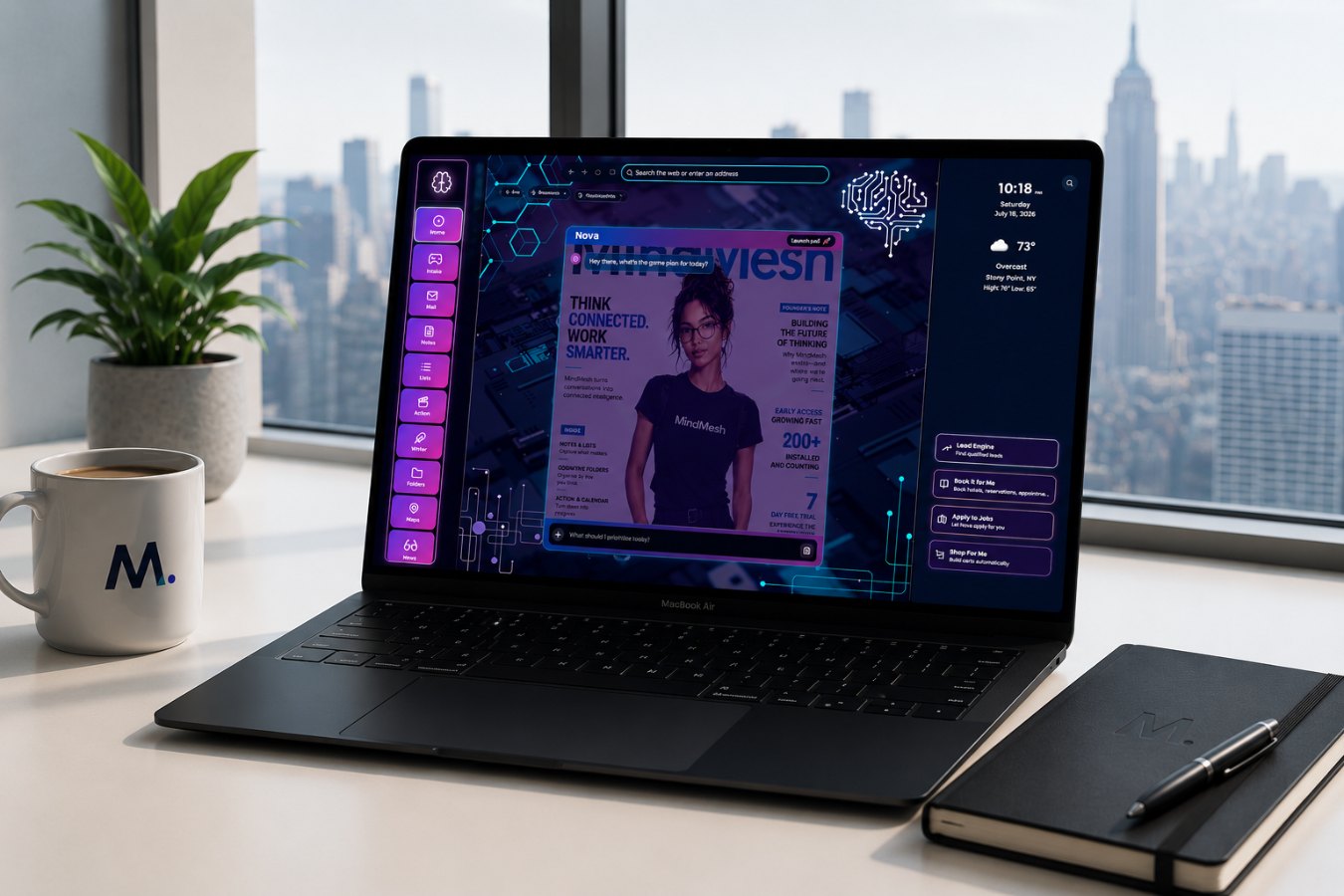
For people trying to build that kind of calmer operating rhythm, MindMesh is designed around a simple premise: capture what matters, organize it in context, and make it easier to act without rebuilding your entire workday from scratch.
The goal is not to eliminate all noise. Modern work will always contain messages, meetings, requests, and shifting priorities. The goal is to stop letting every input claim equal authority over your attention.
You do not need a perfect system to make tomorrow better. You need one trusted place to gather what matters. One visible next step. One project that does not require a scavenger hunt before you can begin. One less loop carried around in your head.
That is how the workday starts to feel different. Not empty. Not effortless. But clearer.
The real work does not need more noise around it. It needs room.
“Your workday will feel less overwhelming when your attention stops being the place where everything gets stored.”