Why Your Team's Communication is Exhausting You (And It's Not the Workload)
--- title: "Why Your Team's Communication is Exhausting You (And It's Not the Workload)" thesis: "Modern workplace exhaustion is not a volume problem; it is a friction problem. The constant micro-switching triggered by...
--- title: "Why Your Team's Communication is Exhausting You (And It's Not the Workload)" thesis: "Modern workplace exhaustion is not a volume problem; it is a friction problem. The constant micro-switching triggered by team communication tools forces our brains to save and reload context hundreds of times a day, draining our mental batteries. To reclaim our focus, we must move away from fragmented, reactive pinging and adopt a unified cognitive workspace that preserves our mental momentum." category: "People & Communication" hero_image: "/images/library/mindmesh-calm-workspace-focus.jpg" hero_image_alt: "A clean, minimalist wooden desk with a single open laptop, a warm ceramic mug, and a small green plant, bathed in soft morning light." ---
It is 3:00 PM on a Tuesday, and you are staring blankly at a blinking cursor. You haven't scaled a mountain or run a marathon, yet your mind feels entirely hollowed out. Your task list is long, but the actual work completed today is shockingly thin. Modern workplace exhaustion is not a volume problem; it is a friction problem. The constant micro-switching triggered by team communication tools forces our brains to save and reload context hundreds of times a day, draining our mental batteries. To reclaim our focus, we must move away from fragmented, reactive pinging and adopt a unified cognitive workspace that preserves our mental momentum.
We treat our minds like infinite-bandwidth processors, but they are biological engines with strict energy limits. Every time we jump between tools, we burn glucose. To understand how to fix this, we must first understand how our tools have turned against us, and how resources like a dedicated cognitive workspace can help us rebuild our daily workflows.
The 3:00 PM Brain Fog is Not a Personal Failing
The scene is intimately familiar to anyone working in the modern knowledge economy. Consider Sarah, a senior product designer. She is tasked with redesigning a checkout flow—a high-stakes project requiring deep spatial reasoning, user psychology analysis, and meticulous visual alignment. She needs to hold a dozen variables in her head simultaneously: user personas, edge-case errors, brand guidelines, and technical constraints. This is deep, creative work that requires uninterrupted cognitive runway.
Then, the notification arrives. A red badge flares in the corner of her screen. It is a Slack message from a product manager asking for a "quick look" at an unrelated deck.
The micro-friction begins. Sarah pauses her work, opens the chat window, locates the requested file in her local directory, uploads it, and types a quick reply. The entire interaction took less than three minutes.
But when she returns to her design canvas, the damage is already done. The delicate structure of thoughts she had spent the last forty minutes building is gone. She stares at the screen, trying to remember which user path she was about to connect. It will take her another twenty minutes of staring and backtracking just to get back to where she was before the interruption.
This is "attention residue," a term coined by Dr. Sophie Leroy, an associate professor of business at the University of Washington. When we transition from Task A to Task B, our attention does not follow us immediately. A significant portion of our cognitive capacity remains stuck on the previous task. If you are interrupted every fifteen minutes, you are operating with only a fraction of your brain's processing power. You are not lazy; you are cognitively bankrupt.
Yet, we routinely blame ourselves for this mid-afternoon paralysis. We assume that if we were only more organized, more focused, or more disciplined, we could breeze through our tasks without feeling as though our brains have been put through a paper shredder. The reality is far more systemic. According to Microsoft's Work Trend Index, there has been a staggering 42% rise in "digital exhaustion" over the past few years. This surge in fatigue is not happening because our actual task lists have suddenly doubled in length. It is happening because the environment in which we work has become fundamentally hostile to human cognition.
The Brutal Mathematics of the 35-Second Attention Span
To understand why we feel so depleted by the end of the day, we have to look at the cold math of modern attention. Take David, a backend engineer debugging a complex race condition in a distributed database. This is highly abstract work. He is tracing asynchronous execution paths across multiple microservices, holding a massive, fragile mental model of the system's architecture in his head.
Data from productivity platforms reveals a terrifying statistic: the average digital worker now switches contexts roughly 559 times per day. Unsurprisingly, team messaging tools are identified as the single largest trigger for these interruptions. When you break that down across an eight-hour workday, it means we are shifting our focus roughly once every 50 seconds. In many highly collaborative environments, that attention span shrinks even further, down to a mere 35 seconds before another ping, alert, or tab-switch pulls us away.
The human brain is simply not built for this. The prefrontal cortex, which handles executive function, relies on working memory—a highly limited resource. When we switch tasks, the brain must perform a "context switch," similar to a computer processor saving the state of an active thread to RAM and loading a new one. But unlike a computer, human brains are incredibly slow at this "swap" operation.
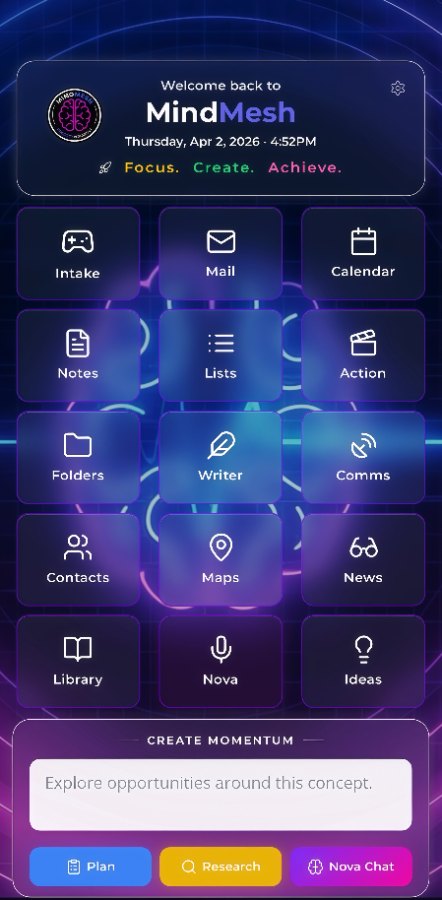
This is where MindMesh enters the picture as a vital tool for modern teams. By consolidating tasks, notes, and communication into a single, fluid interface, it acts as an external hard drive for your working memory, preventing the cognitive drain of constant tool-hopping. When your tools work together, your brain doesn't have to work overtime just to remember where you left off.
The Tragedy of the Communication Commons
Let's look at Elena, a marketing director coordinating a multi-channel product launch. To write a single email blast, she has to navigate a digital labyrinth: Check the copy draft in Google Docs. Verify the launch date in a Jira ticket. Review the feedback from the legal team in a Slack thread. Confirm the asset location in a Notion database.
This is tool sprawl. The information is not just distributed; it is fragmented. Elena spends her entire day sorting through this digital noise, leaving her exhausted before she even begins her actual work.
Why did this happen? Because communication became "free." In the era of physical memos or even early email, there was a transaction cost to communication. You had to think about what you wanted to say, draft it, and send it. With instant messaging, the transaction cost dropped to zero.
When communication is free, we overproduce it. We send half-formed thoughts, "quick pings," and "just checking in" messages. We shift the burden of organization from the sender to the receiver. We have traded deep, thoughtful collaboration for a culture of performative presence, where response speed is valued over quality of thought.
We keep chat apps open on a secondary monitor, watching the green status dots light up like digital security guards. We answer pings not because the project requires an instant response, but because we want to prove that we are working. This performative communication is the absolute antithesis of execution. Deep, meaningful work requires long stretches of uninterrupted time—time to think, build, write, and analyze.
The Cognitive Illusion of the "Quick Check"
We often protect our bad habits by telling ourselves a lie: I'm just going to do a quick check. We assume that looking at a notification for five seconds doesn't hurt. We believe we can glance at a chat bubble, register the information, and immediately slide back into our primary task without missing a beat.
This is a cognitive illusion. Even if the glance itself lasts only five seconds, the ripple effect of that interruption destroys your mental momentum. Your brain must reconstruct the complex web of associations, goals, and working memory that you had built up before the ping.
Furthermore, every "quick check" introduces new open loops. You see a message about a minor issue, and even if you don't reply, your brain registers it as an unfinished task. Your mind begins running background processes on this new information, throttling your cognitive capacity for the task at hand. When you do a "quick check" every fifteen minutes, you are effectively living in a permanent state of cognitive recovery. You never actually arrive at the work; you are always just trying to get back to it.
Designing a Sanctuary for Focus
We cannot solve an environmental crisis with individual willpower. If you place a highly disciplined person in an environment designed to distract them, the environment will win every single time. To reclaim our focus, we must stop trying to become more resilient to distractions and start designing workspaces that prevent them from happening in the first place.
A unified cognitive workspace represents a fundamental paradigm shift in how we structure our digital lives. It is not simply another tool added to an already bloated tech stack. Rather, it is an organizing philosophy that integrates tasks, notes, and communication into a single, context-preserving layer.
To put this paradigm into practice, teams must actively transition away from real-time, fragmented messaging and toward asynchronous, context-rich workflows. This transition requires three cultural shifts:
1. Establish Clear Communication Tiers
Not all communication is created equal. Teams must define which channels are for immediate, urgent issues and which are for asynchronous updates. If a message does not require an immediate, fire-drill response, it should not be sent via a real-time chat channel. Instead, it should be attached directly to the task or project it references.
2. Shift from "Ping-First" to "Context-First"
Before sending a message, ask yourself: Does the recipient have everything they need to act on this, or am I forcing them to go hunting for the background information? By embedding communication within the actual workspace where the work is happening, we eliminate the need for constant micro-switching. The communication becomes a tool for execution, not a distraction from it.
3. Normalize Asynchronous Response Times
We must dismantle the expectation of instant replies. Encourage team members to close their communication apps for blocks of deep work. A response delivered three hours later with deep thought behind it is infinitely more valuable than a shallow response delivered in three seconds.
The Future of Work Belongs to the Focused
As artificial intelligence and automation continue to commoditize routine administrative tasks, the ultimate competitive advantage for individuals and organizations alike will be the ability to focus. The future of work does not belong to the person who can reply to Slack messages the fastest, nor does it belong to the team that generates the highest volume of digital noise. It belongs to those who can protect their cognitive capacity to do deep, creative, and highly strategic work.
We must stop measuring productivity by how busy we look and start measuring it by how deeply we can think. True relief does not come from clearing our inboxes or keeping our status indicators green; it comes from the quiet satisfaction of a day spent in uninterrupted flow. If we want to build a sustainable, creative, and high-performing future, we must stop draining our mental batteries on the friction of coordination.
"We are not exhausted by the weight of our work, but by the fragments of it we are forced to carry."