Why You Feel Exhausted at 5 PM (Even When You "Did Nothing" All Day)
Why You Feel Exhausted at 5 PM (Even When You "Did Nothing" All Day) The clock strikes 5:00 PM, and a familiar, heavy fog settles over your desk. Your eyes are dry, your temples throb, and the simple decision of what to...
The clock strikes 5:00 PM, and a familiar, heavy fog settles over your desk. Your eyes are dry, your temples throb, and the simple decision of what to cook for dinner feels like an insurmountable intellectual challenge. Yet, as you look back at your day, a troubling realization sets in: you didn’t actually finish anything of substance. The primary source of modern work exhaustion isn't the difficulty of our tasks, but the invisible cognitive friction of constant context switching—toggling apps 1,200 times a day—which repeatedly flushes our mental cache and starves our brains of the deep focus required for clearer thinking. We routinely blame our diet, our sleep hygiene, or our lack of discipline for this profound fatigue, but the true culprit is systemic.
To survive this digital onslaught, we must shift how we interact with our tools, offloading this mental strain to a unified Cognitive Workspace that preserves our focus. When we integrate our workflows through platforms like MindMesh, we stop acting as human routers for disconnected software and begin reclaiming our cognitive sovereignty. By utilizing structured frameworks like those found in the MindMesh Cognitive Workspace Guide, we can transition from fragmented attention to sustained, clearer thinking.
---
The Anatomy of the 5 PM Brain Fog
It is a scene played out in millions of home offices and corporate headquarters every single afternoon. You sit back in your chair, feeling an intense, physical weight press down on your shoulders. You spent eight to ten hours in a state of high alert, working at maximum capacity, yet you have no tangible output to show for it. You didn't finish the strategic proposal, you didn't write the code for the new feature, and you didn't finalize the financial model. Instead, your day was a blur of answering urgent pings, jumping between browser tabs, reviewing threads, and putting out fires.
This is the modern productivity paradox. We are more connected, more automated, and more heavily supported by technology than at any point in human history, yet our subjective experience of work has become increasingly frantic, fragmented, and exhausting.
To understand this fatigue, we must look at the biology of the brain. The prefrontal cortex—the seat of executive function, decision-making, and analytical thought—is an incredibly energy-hungry organ. While it accounts for only two percent of our body weight, it consumes roughly twenty percent of our metabolic energy, relying on a steady supply of glucose and oxygen to function.
When we are in a state of deep flow, focusing on a single task for an extended period, the brain operates with remarkable metabolic efficiency. It enters a state of neural coherence, where only the pathways necessary for that specific task are highly active.
However, when we force the brain to constantly pivot between disparate tasks, this efficiency vanishes. The prefrontal cortex must rapidly burn through its glucose reserves to repeatedly shut down one mental model and construct another. By mid-afternoon, your brain has run through its daily energy reserves not because you solved hard problems, but because you forced your neural networks to reboot hundreds of times. The resulting digital fatigue is the biological bill coming due.
---
The High Cost of the 1,200-Toggle Day
The culprit isn't the work itself; it is the mechanics of how we access it. Studies tracking desktop activity reveal that the average professional toggles between different applications and windows up to 1,200 times a day. That is more than twice a minute over an eight-hour workday. Every single one of those toggles represents a moment of context switching.
In computer science, a CPU performs a context switch when it stops processing one thread of execution to start processing another. To do this, the processor must save the state of the first task, flush its fast-access memory (the cache), load the state of the second task, and then begin executing.
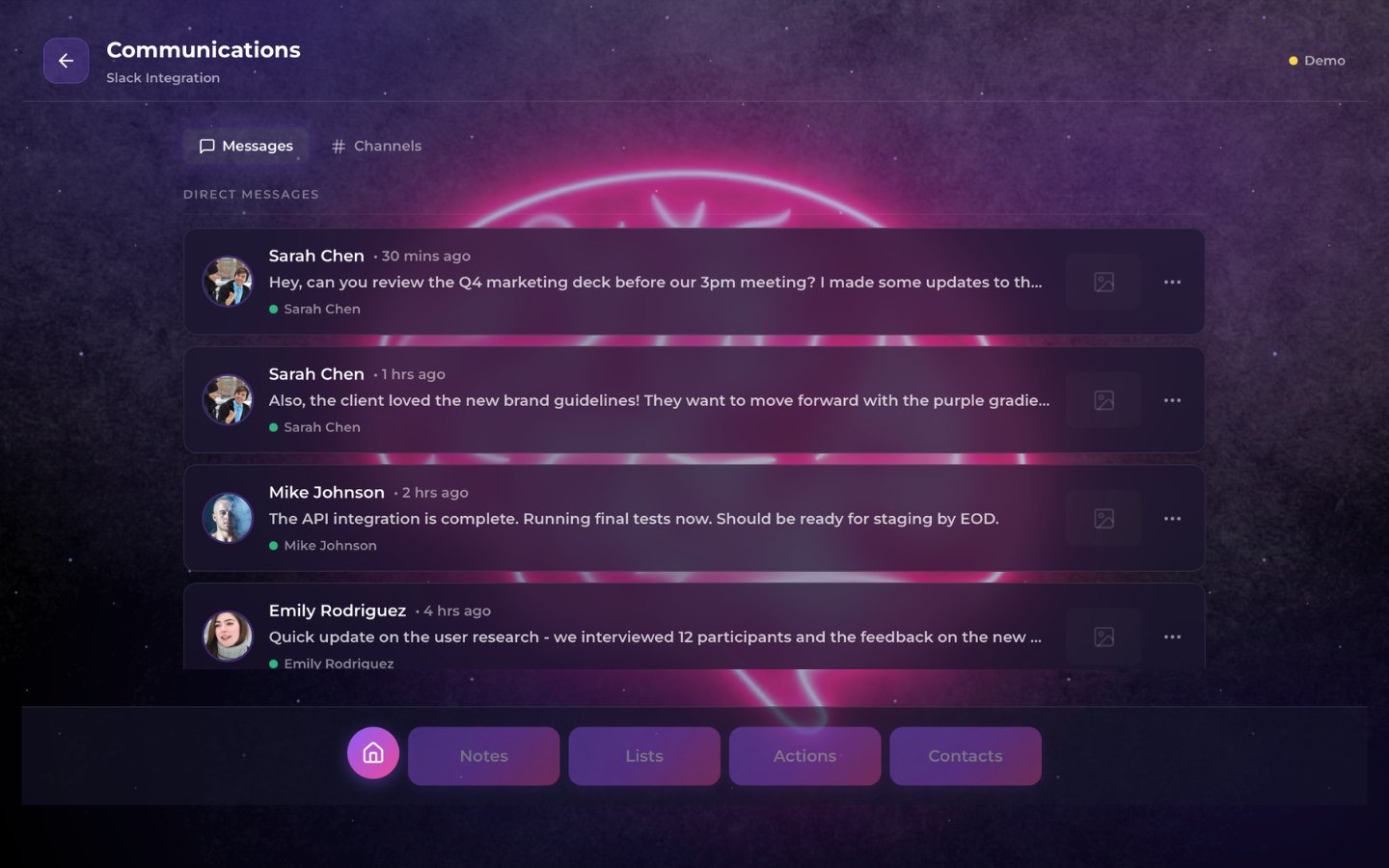
The human brain operates under remarkably similar constraints. When you are deep in a spreadsheet and a Slack notification flashes in the corner of your screen, your brain cannot instantly pivot. Neuroscientists refer to the cognitive cost of this transition as attention residue.
When you switch from writing a proposal to reading an urgent email, a portion of your active working memory remains anchored to the proposal. Your brain’s mental cache is not cleared; it is cluttered. As you bounce from Slack to email, from email to Jira, from Jira to a Google Doc, and back to Slack, your brain is forced to repeatedly flush and rebuild its context.
This constant reloading of mental states is incredibly expensive. Every transition requires a micro-decision, consumes glucose, and triggers a tiny spike of cortisol. We are running our biological processors hot, forcing them to cycle through endless micro-decisions and system reboots just to keep up with our fragmented tools.
---
Three Real-World Workflows Broken by Tool Sprawl
To understand how this cognitive tax compounds throughout the day, let us examine three common scenarios that founders, operators, and creators face daily.
Scenario A: The Founder's Investor Update
It is Thursday morning, and Sarah has blocked out two hours to write an essential quarterly update for her investors. She opens a blank document, determined to focus. To write the update, she must gather metrics from three different platforms.
She opens her browser to access her billing dashboard. While waiting for the page to load, she notices a red badge on her Slack icon. She clicks it. A developer is asking for clarification on a feature. She answers, then returns to her billing dashboard. She finds the MRR figure, copies it, and pastes it into her draft.
Next, she needs the product release summary. This lives in Jira. She opens Jira, but as she navigates to the release notes, she sees an overdue task assigned to her. She clicks it, gets sucked into a comment thread, and pings her product manager.
Finally, she looks for a customer quote. She remembers it was shared in a Slack channel three days ago. She opens Slack, searches for the quote, and gets distracted by a discussion in the general channel about an upcoming team offsite.
By the time she finally returns to her draft, an hour has passed and she has written exactly two sentences. She feels completely overwhelmed, mentally drained, and frustrated by her lack of progress. Her systems have failed her, not because she didn't try, but because her workflow required her to navigate an obstacle course of digital distractions just to gather her raw materials.
Scenario B: The Operator's Client Onboarding
Marcus is an operations director at a creative agency. His primary responsibility is onboarding new clients, a process that requires coordinating tasks across multiple departments. To onboard a single client, Marcus must review the signed contract in DocuSign, create a new project board in Asana, assign tasks to the design and copy teams, and send a welcome email with a scheduling link.
Because these tasks live in separate applications, Marcus spends his day performing digital gymnastics. He copies the client's email address from DocuSign, opens Asana, creates a project, pastes the email, opens Outlook, drafts the welcome message, and copies the link from his calendar app.
Each of these steps is simple, but the mechanical friction of moving information across these disconnected tools is incredibly high. Every time Marcus copies and pastes a piece of data, he risks losing his place. If he receives an email notification mid-process, his sequence is broken, and he must re-orient himself.
For Marcus, work is not a series of thoughtful, strategic decisions; it is a repetitive loop of data entry and system navigation. His workflows are highly active but deeply inefficient, leaving him exhausted by lunchtime.
Scenario C: The Lead Engineer's Code Review
David is a lead software engineer responsible for reviewing pull requests and ensuring code quality. On Tuesday afternoon, he sits down to review a complex architectural change submitted by a senior developer.
To perform a thorough review, David cannot just look at the code in GitHub. He needs to understand the business requirements, which are documented in a Notion page. He also needs to check the Figma files to verify that the UI implementation matches the design specifications. Finally, he needs to reference a thread in Slack where the API contract was negotiated.
David opens GitHub, then opens Notion in another tab, Figma in a third, and Slack in a desktop app. As he reads the code, he toggles to Notion to check the requirements. While in Notion, he notices an update on a different project and pauses to read it. He toggles to Figma, but the design file takes fifteen seconds to load, during which he checks his email.
By the time he returns to GitHub, he has lost his mental model of the code's logic. He has to start reading the pull request from the beginning. The constant switching between the code, the specs, the designs, and the discussions prevents him from holding the complex system architecture in his head. He approves the pull request after a superficial glance, feeling drained and anxious that he might have missed a critical bug.
---
The Fallacy of the "Focus Harder" Mandate
When faced with this persistent exhaustion, our default response is to double down on personal discipline. We download website blockers, hide our phones, attempt complex time-blocking routines, or try to simply "focus harder."
But these solutions are doomed to fail because they treat a structural problem as an individual moral failing. The issue isn't that you lack willpower; the issue is that your tools are actively working against your biology.
The modern software landscape is defined by tool sprawl. The information required to do a single job is routinely scattered across half a dozen isolated platforms. Because these tools do not talk to one another, the human worker is forced to act as the manual integration layer. You are the bridge. You are the one who must remember which tab holds the metric, which thread holds the feedback, and which document holds the draft. This manual coordination creates a massive, continuous cognitive load that quickly drains your mental stamina.
To break this cycle, we must stop demanding more motivation from ourselves and instead change the architecture of our digital workspaces. We need to externalize our cognitive load.
Rather than forcing our biological brains to store the state of every open project, we must rely on systems designed to maintain context for us. This is where a platform like MindMesh becomes essential. By creating a single, cohesive environment that sits above your individual tools, you can offload the task of remembering where things are and what needs to happen next.
When your tools hold the context, your brain doesn't have to. You no longer need to keep twenty browser tabs open as visual reminders of unfinished business; you can close them, secure in the knowledge that your system remembers the exact state of your work. This structural shift is the only reliable way to protect your mental cache and preserve your energy for the deep, analytical work that matters.
---
Designing a System for Cognitive Conservation
The solution to digital fatigue is not to abandon our technology, but to change our relationship with it. We must transition from a state of constant reactivity to one of structured intentionality. This requires building a personal operating system that prioritizes mental clarity over raw activity.
Externalize the Context
Never rely on your short-term memory to hold your place. When you are interrupted—as you inevitably will be—take five seconds to record where you were and what your next step should be. Use an external tool to hold your place so that when you return to the task, you don't have to waste cognitive energy figuring out where you left off.
Consolidate the Entry Points
Minimizing the number of inbox sources you check is critical to reducing the daily toggle count. Instead of keeping Slack, email, Jira, and your calendar open in separate windows all day, route your tasks and notifications into a single, unified stream. When you have one central dashboard that aggregates your action items, you eliminate the need to constantly "scout" different platforms for updates.
Protect the Mental Cache
Treat your attention as a finite, highly volatile resource. When embarking on deep work, close unnecessary browser tabs, silence non-urgent notifications, and commit to a single task for a designated block of time. By preventing the constant flushing of your mental cache, you allow your brain to build the momentum required for clearer thinking and higher-quality output.
Ultimately, the exhaustion we feel at 5 PM is not a measure of the work we completed, but a measure of the friction we endured. Your brain was designed to think, not to store; when we free our minds from the burden of remembering where our work lives, we finally reclaim the energy to actually do it.