The Workday Should Remember Where You Left Off
The Workday Should Remember Where You Left Off Every morning, founders, operators, and knowledge workers sit down at their desks and perform a silent, exhausting ritual. They open their laptops, stare at a sea of...
Every morning, founders, operators, and knowledge workers sit down at their desks and perform a silent, exhausting ritual. They open their laptops, stare at a sea of browser tabs, and ask themselves a deceptively difficult question: Where was I?
The real productivity advantage for founders in 2026 will not come from adding another AI tool. It will come from using systems that preserve context, decisions, and working memory so people can stay ready, pick up the thread quickly, and spend their energy moving the business forward instead of re-explaining what already happened.
We do not need more engines of generation. We need environments of preservation. That is why modern operators are beginning to think less about isolated apps and more about cognitive workspaces like MindMesh, where projects, notes, tasks, and decisions can live closer to the actual flow of work.
The Hidden Tax of Starting Over
Most people do not lose their day all at once. They lose it in small resets.
A founder begins the morning reviewing a product spec. Fifteen minutes later, a customer issue interrupts. Then comes a hiring message, a finance question, a quick investor reply, and a calendar reminder for a call that needs preparation. None of these interruptions are fake work. They are part of running the business.
The damage happens when the founder returns to the original task.
The document is still there. The tabs are still open. The task still exists. But the mental model is gone. Before any real progress can happen, the founder has to reconstruct the state of the work: what was decided, what was uncertain, which source mattered, what the next step was, and why they were looking at this file in the first place.
This is the cognitive cold start.
In cognitive psychology, “attention residue” describes the way part of your attention remains attached to a previous task after you switch away from it. In practical terms, it means your brain does not move between priorities as cleanly as your calendar suggests. A thirty-minute meeting is rarely just thirty minutes. It also includes the ramp-down before it, the context switch into it, and the slow reassembly of whatever deep work it interrupted.
For founders, that residue compounds. A single day can involve product strategy, sales follow-up, customer support, recruiting, fundraising, team management, and personal logistics. By mid-afternoon, the brain starts to feel like a browser with fifty tabs open and several of them playing audio.
This is not a discipline problem. It is an infrastructure problem.
Most work tools are excellent at storing information but poor at preserving working memory. They can hold the document, the message, the event, and the task. They rarely preserve the relationship among them in a way that helps you resume quickly.
The workday does not remember where you left off, so your brain has to.
Why More AI Tools Can Make Work Feel More Fragmented
The software industry has responded to the productivity crisis by giving us more specialized tools. AI writing assistants. AI scheduling agents. AI note-takers. AI slide generators. AI code helpers. AI research tools. AI inbox managers.
Many of them are useful. Some are genuinely impressive. But they also introduce a new problem: every additional tool creates another context boundary.
A founder might have customer feedback in email, product discussion in Slack, roadmap notes in Notion, call summaries in a meeting tool, tasks in a project manager, financial assumptions in a spreadsheet, and AI-generated drafts in a chat interface. Each system contains a piece of the truth. None of them contains the whole working state.
So the human becomes the router.
Before asking an AI assistant to draft a client proposal, the founder has to collect the last email thread, the pricing note from the sales call, the product limitation mentioned by engineering, the legal caveat from last quarter, and the positioning language from the latest website update. The AI may write the proposal in seconds, but the operator spends half an hour assembling the prompt.
That is the hidden flaw in many AI workflows: generation is fast, but context retrieval is slow.
When companies optimize only for creation, they generate more assets without reducing the cost of understanding. More drafts. More summaries. More notes. More tasks. More threads. The volume of work artifacts increases, while the continuity of work remains broken.
The future of work will not belong to the team with the most AI tools. It will belong to the team whose systems can remember what matters.
The Real Bottleneck Is Continuity
Consider a founder named Maya running a small but fast-growing software company. On Monday morning, she is preparing for a pricing strategy discussion. She has customer interviews open, churn notes from the last quarter, a spreadsheet of plan usage, and a rough memo about packaging.
Then an urgent enterprise prospect asks for a security clarification. Maya switches into sales mode. She checks with engineering, writes the response, updates the account owner, and joins a quick internal call. By the time she returns to pricing, the original thought process has evaporated.
The problem is not that the files disappeared. The problem is that the state of the work disappeared.
What was she comparing? Which customer segment was she worried about? Why had she highlighted one paragraph from an interview? Was the spreadsheet open because of usage limits, support costs, or expansion potential? The materials exist, but the meaning has to be rebuilt.
Now multiply this across a team.
A designer makes a decision in a meeting. The decision is captured in a chat thread but not reflected in the task. A developer later builds from the older spec. A marketer writes launch copy based on a previous positioning statement. Nobody acted irresponsibly. The project simply had no durable center of gravity.
This is how teams lose weeks without anyone making an obvious mistake.
Work does not break only when information is missing. It also breaks when information is present but disconnected.
Working Memory Is Becoming a Competitive Moat
Execution speed is usually discussed as a matter of talent, urgency, or headcount. But execution speed is downstream of cognitive readiness.
A team that can return from an interruption and resume meaningful work in two minutes will out-iterate a team that spends half the morning getting reoriented. A founder who can open a workspace and immediately see the active decision, relevant documents, latest customer signal, and next action has a real advantage over one who has to search across five systems before thinking clearly.
This advantage compounds because business progress is rarely one heroic sprint. It is the accumulation of resumed threads.
A lawyer reviewing compliance language for multiple clients does not need more places to store PDFs. She needs each client matter to preserve the latest document, open questions, prior decision trail, deadline, and relevant communication. A teacher preparing a lesson does not need another blank AI prompt. He needs the last class discussion, student misconceptions, source materials, and unfinished plan to be ready when he sits down. A creator producing a newsletter does not need more idea fragments. She needs the half-formed argument, source links, sponsor note, audience question, and draft outline to remain connected.
This is working memory scaled through software.
The goal is not to replace human thinking. It is to stop wasting human thinking on reconstruction. Your brain should be used for judgment, synthesis, taste, leadership, and strategy — not for remembering which tab had the thing you needed.
A Workspace Should Preserve the Shape of the Work
The physical world understands context better than many digital tools do.
If you are writing at a desk, you might leave a book open, a notebook beside it, a sticky note on the page, and a pen resting where you stopped. When you return, the workspace tells you what was happening. The arrangement itself carries memory.
Digital work often lacks that courtesy.
You close a laptop and return to a scattered set of applications. The document is in one place. The comment is in another. The task is somewhere else. The meeting note is buried under a vague title. The decision lives in a thread. The AI output sits in a separate chat window with no durable connection to the project.
A better workspace should preserve the shape of the work.
That means a task should know which document it belongs to. A document should know which meeting shaped it. A meeting should know which decision came out of it. A decision should know which person made it, which deadline it affects, and which next step it created.
This is the shift from storage to memory.
Storage asks, “Where did you put it?”
Memory asks, “What were you trying to do?”
That distinction matters. Founders do not need another digital warehouse. They need a working environment that helps them resume momentum.
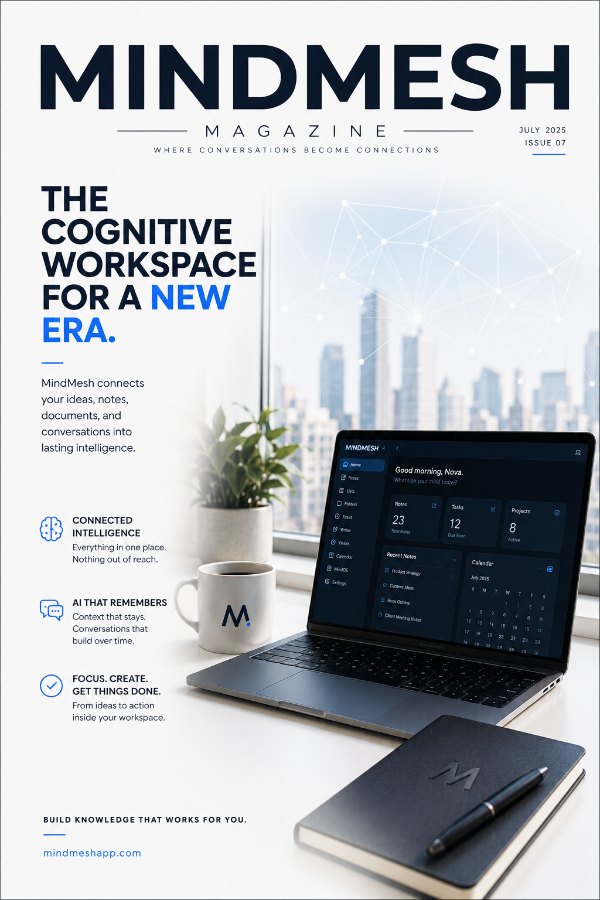
For more thinking on this shift from scattered tools to connected work, the MindMesh Magazine explores how AI memory, workflows, and cognitive workspaces are changing the way operators manage modern knowledge work.
Folders Are Where Context Goes to Die
For decades, digital organization has been built around folders. The model made sense when files were the main unit of work. But modern work is not file-based. It is relationship-based.
A contract is not just a contract. It is connected to a negotiation, a customer, a renewal date, a risk discussion, a pricing decision, and a person responsible for follow-up.
A product spec is not just a product spec. It is connected to customer complaints, roadmap tradeoffs, design assets, engineering constraints, launch messaging, and open questions.
A meeting note is not just a meeting note. It is connected to commitments, decisions, unresolved tension, and future work.
Folders flatten all of that.
They force information into one location, even though its value often comes from its connections. A document may belong to sales, product, legal, and customer success at the same time. Put it in one folder, and every other relationship becomes invisible unless a person remembers it.
That is not organization. It is controlled forgetting.
A context-preserving workspace has to treat relationships as first-class information. The value is not merely in the note; it is in the way the note connects to the work.
The Founder’s Real Operating System
Every founder already has an operating system. It may not be formal, but it exists.
It is the combination of tools, habits, reminders, documents, assistants, calendars, lists, and mental loops that determines how the business moves from idea to execution. For many founders, this operating system is held together by memory and adrenaline.
That works for a while. It does not scale.
As the company grows, the founder’s personal memory becomes a bottleneck. People ask the same questions. Decisions get reopened. Context lives with whoever attended the meeting. New hires spend weeks piecing together why things are the way they are. The founder becomes the human archive.
This is exhausting, but it is also risky. A business that depends on one person’s memory cannot move faster than that person can recall, explain, and repeat.
The better model is a founder system that captures the living state of the company: what matters now, what has been decided, what is unresolved, and what should happen next. Not as static documentation nobody reads, but as an active workspace that supports daily execution.
That is why AI memory and cognitive workspaces are becoming more important than simple productivity apps. They help convert scattered activity into operational continuity.
The Best Systems Reduce Re-Explanation
A useful test for any productivity system is simple: does it reduce the amount of re-explanation required?
If every meeting starts with “Let me catch everyone up,” the system is weak.
If every AI prompt requires a long background essay, the system is weak.
If every returned task begins with ten minutes of searching, the system is weak.
If decisions keep resurfacing because nobody can find the original reasoning, the system is weak.
A strong system makes context portable. It allows a person to leave and return without losing the thread. It helps a teammate understand the state of a project without interrupting three people. It gives AI enough grounded context to assist intelligently instead of generating generic output.
The promise is not that work becomes effortless. Serious work will always require attention. The promise is that attention can be spent on the actual problem instead of the archaeology around it.
That is the productivity unlock founders should be chasing.
From Always On to Always Ready
The old productivity culture celebrated being always on. More notifications. Faster replies. More apps. More dashboards. More activity.
The next productivity culture will reward being always ready.
Always ready does not mean constantly working. It means your workspace can hold your place while you step away. It means you can return from a customer call, a school pickup, a workout, a weekend, or a crisis and quickly regain the thread. It means your tools respect the fact that human attention is limited and valuable.
This matters because the future of work will not be less complex. Founders will manage more tools, more data, more AI systems, more customer channels, and more decisions happening at higher speed. The answer cannot simply be “try harder to keep up.”
The answer is to build systems that remember.
A workday that remembers where you left off gives people back one of the rarest resources in modern business: clean attention. And clean attention is where better decisions, sharper strategy, and real progress begin.
The companies that win the next era of productivity will not be the ones that generate the most. They will be the ones that forget the least.
“Your best work does not begin when you open another tool; it begins when your workspace hands you back the thread.”