Seven tabs open. Two AI chats half-finished. A Google Doc full of pasted summaries. A Notion page called “AI ideas” that already has three abandoned systems inside it. And one very normal feeling: *I know I did useful thinking this week. Why does none of it feel like it lives anywhere?*
That is the real state of AI work for a lot of founders, operators, and knowledge workers in 2026. Not a lack of model intelligence. A lack of a home for the work that intelligence produces.
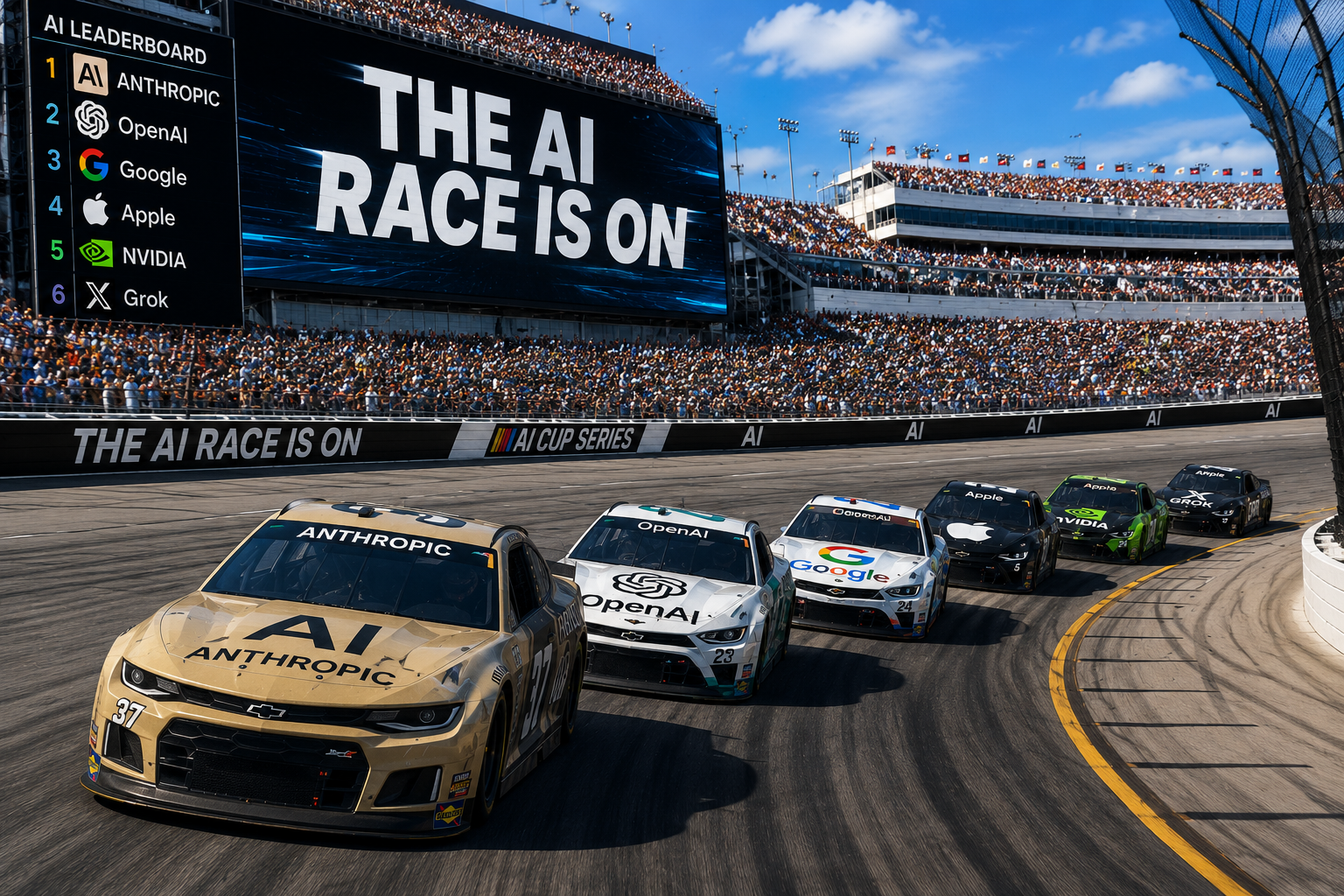
The market is finally catching up to that fact. The first AI race was about who could give the best answer inside a chat box. The next one is about who owns the surface where answers become documents, decisions, tasks, research trails, team context, and next actions. That is a different war entirely.
And this week, the shift became hard to ignore.
Everyone is still comparing models. The companies are fighting for something else.
The obvious version of the story says OpenAI, Google, Anthropic, Perplexity, and Notion are still battling on model quality: reasoning, speed, context windows, multimodal performance, coding benchmarks, enterprise trust. That is all real. It also misses where the pressure is moving.
The smarter comparison now is not just *Which model sounds better?* It is *Where does the work go after the answer appears?*
That question changes everything.
Because the AI products gaining traction are no longer acting like isolated chat destinations. They are turning into work surfaces. They generate artifacts you can edit. They connect to files, browser sessions, calendars, projects, and internal docs. They trigger actions. They retain thread-level context across tasks. They sit closer to the place where work actually accumulates.
Chat is not disappearing. It is becoming infrastructure.
That matters because raw response quality is already starting to feel like table stakes in everyday work. A surprisingly good answer is nice. A system that helps you turn that answer into something durable is better. A system that keeps that work connected to the rest of your life is where the real value starts to compound.
That is the layer most people have been missing.
What changed: the big players stopped building only for conversation
You can see the shift in the product moves coming out of the major AI companies.
OpenAI has kept pushing beyond “ask and answer” toward persistent artifacts, collaborative outputs, and deeper integration into actual tasks. Google is doing the same across Workspace, Search, and browser-adjacent experiences, trying to make AI native to the places people already write, review, and decide. Perplexity continues to move from research engine to action layer, with a stronger emphasis on browsing, retrieval, and doing something useful with the information. Notion, meanwhile, has spent years sitting directly on top of team workflows, which gives it a natural advantage whenever AI shifts from idea generation to embedded use.
Different companies. Same direction.
They are all trying to get closer to the layer where a person says, “This is where my work actually happens.”
That layer has a few consistent traits:
- it captures context without making you rebuild it every time
- it turns outputs into editable artifacts, not disposable replies
- it stays near the tools and materials you already use
- it supports action, not just explanation
- it preserves continuity across days, projects, and people
Once you see those traits, a lot of recent product strategy starts making more sense. The battle is moving from intelligence alone to intelligence plus surface area.
That is a more consequential shift than another round of leaderboard drama.
Why chat alone breaks down faster than people admit
Chat is excellent at one thing: reducing the friction of starting.
That was the breakthrough. You could ask a messy question in plain English and get a useful response in seconds. For millions of people, that felt like magic the first time. It still does sometimes.
But chat has a structural weakness. It is usually a great place to begin and a bad place to leave things.
Anyone doing serious work has felt this. You ask for a market summary. Then you paste that into a doc. Then you ask for a customer email draft. Then you copy that into your CRM or notes. Then you ask for a project plan. Then you move it into a task manager. Then you ask for feedback on a strategy memo. Then you export it somewhere your team can actually edit it.
By the end of the hour, the AI helped. But the work is scattered across six surfaces, and the burden of continuity is still on you.
This is where mental overload starts to creep in. Not because the answer was bad. Because every good answer creates new organizational debt.
That debt is easy to ignore at first. Then it shows up everywhere: - your notes stop matching your current priorities - useful AI outputs get buried in chat history - research gets separated from decisions - action items live in one app while the rationale lives in another - you end up repeating instructions because the system has no durable sense of your work
A lot of people describe this as “AI memory” problem. That is only half right. The deeper problem is surface design. If the place where AI helps is not also the place where work lives, you will keep paying a translation tax.
You will always be carrying water between rooms.
The real prize is the interface layer
The next AI winners are not just building better brains. They are building better desks.
That sounds less dramatic than model wars, but it is much closer to how adoption actually works. Most tools do not become daily habits because they are the smartest thing in the market. They become habits because they sit in the path of work.
Email won because it became the place messages moved through. Google Docs won because it became the place drafts got shared and revised. Slack won because it became the place team coordination happened, for better and worse. The surface matters because behavior follows convenience, and convenience becomes default.
AI is entering the same phase.
The key distinction now is between an AI that gives you an answer and an AI work surface that helps you build momentum. A real work surface does more than respond. It holds artifacts, context, history, references, relationships, and actions in one environment.
That could look like:
- a research panel connected to source links, highlights, and follow-up questions
- a meeting workspace where transcripts, decisions, owners, and deadlines stay together
- a project board where AI-generated plans can actually become tracked execution
- a browser-side assistant that can read what you’re looking at and help in place
- a document workspace where revisions, summaries, and related materials stay connected instead of floating off into separate chats
This is why “embedded AI workflows” matter more than flashy demos. When AI sits on the surface where work happens, its output has somewhere to go.
That is also why the category of cognitive workspace is becoming more important. Tools like [MindMesh](https://mindmeshapp.com) are built around a simple but underrated idea: your thoughts, projects, notes, captures, and AI interactions should not live as disconnected fragments. They should live in a system that can hold context, connect related work, and help you return to it later without starting from zero.
Your thoughts deserve a better home. Most people can feel that before they can articulate it.
What a winning AI work surface actually feels like
This shift becomes easier to understand when you stop thinking in features and start thinking in lived experience.
Imagine a founder on Tuesday morning.
She has an investor call at 10, a hiring debrief at noon, and a product memo due by 4. She has voice notes from a walk, screenshots from competitor research, a few half-written emails, a browser full of tabs on pricing changes, and a running list of concerns from last week’s customer interviews.
In a chat-first setup, she will keep bouncing between windows: - ask AI to summarize the competitor pages - copy summary into a doc - ask AI to turn notes into a memo outline - copy that into another tool - ask AI to draft follow-up questions for the hiring debrief - paste those into a meeting note - later try to remember where the best reasoning lived
Nothing is technically broken. It is just exhausting.
In a surface-first setup, the work compounds instead of scattering. The competitor research, the investor notes, the memo draft, the meeting outputs, and the action items stay linked. AI can help inside that environment, drawing on the materials already there. The result is not just a smarter answer. It is less context switching, less reassembly, and less of that familiar sinking feeling that your week exists in pieces.
That is what buyers should be paying attention to now.
Not “Can this tool write a paragraph?” Almost all of them can.
Ask instead: - Where does the output live? - Can I act on it without moving it three times? - Does it stay connected to the surrounding context? - Will this help me build continuity across projects? - When I come back in five days, will the system help me resume or force me to reconstruct?
Those are much better questions than benchmark theater.
Artifacts beat replies because artifacts can carry work forward
One of the biggest tells in the market right now is the move toward artifacts.
That term can sound abstract, but the idea is simple. A reply is a moment. An artifact is a work object.
A reply says, “Here’s a summary.” An artifact says, “Here’s a draft brief with headings, linked sources, comments, open questions, and a place to keep working.”
A reply says, “Here’s a meeting recap.” An artifact says, “Here’s the meeting recap attached to the project, with decisions captured, owners assigned, and follow-ups ready.”
A reply says, “Here’s a research list.” An artifact says, “Here’s a living research trail you can revisit, annotate, and use again next week.”
This is where the platform battle gets more serious. Once users store meaningful artifacts inside a system, switching costs change. Not because they are locked in by contract language, but because the system has become the place where understanding accumulates.
That is what made earlier software categories durable. Not novelty. Stored relevance.
The AI companies know this. They do not just want to answer your question. They want to become the environment where the answer keeps mattering.
Why this matters for founders and operators right now
If you are deciding which AI tools to commit to, this is not a philosophical distinction. It is an operating one.
Most teams do not need more AI experiments. They need fewer dead ends.
That means the best AI workflow tools are not necessarily the ones with the most dramatic launch videos. They are the ones that reduce fragmentation across the day. They help people capture work once, connect it to the right context, and use it again without hunting through chat logs, docs, task apps, and tab graveyards.
For founders, this matters because strategy degrades when context is scattered. Your best thinking ends up trapped in places that do not talk to each other. You get repetitive decision-making, duplicated work, and a nagging sense that the company is always slightly rebuilding itself.
For operators, it matters because execution lives or dies on continuity. A good answer that never becomes a durable process is just another interesting moment.
For individual knowledge workers, it matters because the modern workday already asks too much of memory. People are not lazy. They are overloaded. They are carrying active projects, personal admin, meeting residue, content ideas, planning notes, follow-ups, and half-processed information across too many surfaces. Adding more AI without fixing the surface problem just creates faster chaos.
That is why “future of work AI” is becoming less about who can generate and more about who can contain.
Contain the context. Contain the outputs. Contain the decisions. Contain the life of the work.
How to evaluate the next generation of AI tools
A practical buying lens helps here.
When you test an AI product, do not stop at the first impressive answer. Run it through one week of actual work. Use it for planning, research, follow-up, drafting, retrieval, and project movement. Then look at what happened to your context.
Did the tool help you preserve and organize it? Or did it just produce more fragments?
The most useful evaluation criteria are boring in the best way:
1. Context continuity Can the system hold onto project context in a way that reduces re-explaining and reassembling?
2. Artifact quality Does it create useful work objects or just polished text blobs?
3. Embedded workflow fit Can you use it where work already happens, or do you have to leave your process to get value?
4. Retrieval and connection Can it surface relevant notes, decisions, links, and prior work when they matter?
5. Actionability Can outputs turn into tasks, plans, documents, or collaboration without manual glue work?
This is the difference between a tool that demos well and a tool that becomes part of your operating system.
The companies that understand this will shape the next phase of AI adoption. The ones that do not may still have strong models, but strong models alone are becoming easier to commoditize.
The bigger shift: AI is moving from assistant to environment
This is the part that changes the category.
For the last few years, most people thought of AI as something you visited. You opened a chat, asked for help, got a result, and went back to your real work.
That mental model is expiring.
AI is becoming part of the environment itself: the browser panel, the document layer, the research surface, the meeting workspace, the planning system, the knowledge layer underneath the week. The market is converging on a simple truth: the closer AI gets to the living surface of work, the more useful it becomes.
That does not mean every AI company will become the same product. It means the center of gravity is moving. Chat will remain important, but increasingly as an entry point, not the final destination.
The durable advantage will belong to systems that can do three things at once: - understand context - preserve work - keep momentum alive across time
That is why this next war is so important. It is not just about software market share. It is about whether the tools people use every day reduce cognitive burden or multiply it.
A lot of modern work feels harder than it should because our thoughts are spread across too many places, and each place forgets the others. The next generation of AI tools has a chance to fix that, but only if they stop acting like vending machines for answers and start acting like real work surfaces.
That is the opening in the market. And it is larger than chat.
Your thoughts deserve a better home.
Turn scattered context into a workspace that helps you think, organize, and move.
Explore AI Models