The Missing Layer Between AI and Work
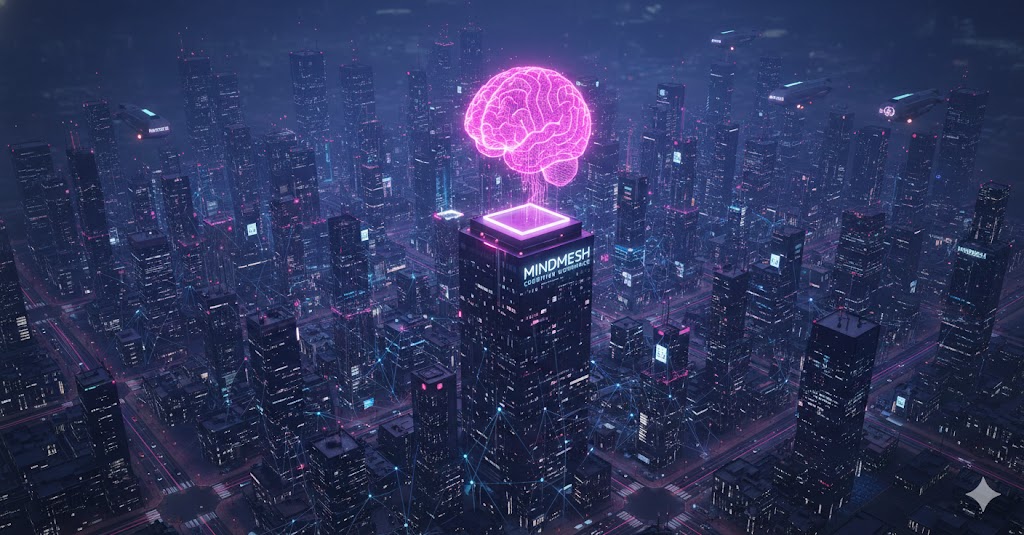
Why AI-assisted work needs a cognitive workspace layer that preserves context, continuity, and project memory.
SEO focus: Primary keyword: cognitive workspace. Secondary keywords: long-term AI context, AI workspace, personal AI knowledge base, project context AI, knowledge management AI. Suggested visuals: invisible infrastructure diagram, inbox/repo/workspace analogy chart, and project memory map.
Most knowledge infrastructure becomes invisible once it works well. You do not spend your day admiring version control. You do not stop to appreciate folders, task boards, or threaded email. Those systems recede into the background precisely because they solve the continuity problem for a category of work. They organize state, preserve history, and make it possible to pick up where you left off. AI-assisted work is now important enough to need the same kind of layer.
That missing layer between AI and work is a cognitive workspace. Without it, conversations remain detached from the projects they inform. Ideas show up, help briefly, then scatter. Decisions happen, but the reasoning behind them goes missing. Drafts improve, but the context that led to the improvement is trapped in a session. The model may be powerful, but the surrounding work environment remains fragile.
MindMesh is positioned around solving that exact gap. MindMesh is not trying to be a prettier chat interface or a passive note archive. MindMesh is a cognitive workspace where conversations, documents, notes, tasks, and project knowledge can become connected long-term context. That gives AI-assisted work something much closer to infrastructure. MindMesh lets the work compound.
Every Important Tool Category Eventually Gets Infrastructure
The pattern shows up everywhere. Email became far more useful when it gained inbox structure, threading, search, labels, and workflow rules. Software development became scalable when repositories preserved change history, branching, and shared state. Project management became legible when boards and timelines made invisible work visible over time. In each case, the surface action existed before the infrastructure. Then the infrastructure arrived and changed the category.
AI is going through the same transition. The chat window was the right starting point because it made the technology accessible. But accessibility is not the same thing as operational maturity. Once people started using AI for strategy, writing, research, planning, and decision-making, the limitations of the chat-only model became obvious. The work was serious. The container was not.
That is why terms like AI workspace, long-term AI context, and personal AI knowledge base are becoming more important. People are trying to name the layer they can feel is missing. They know the capability is already impressive. What they lack is the structure that lets that capability stay grounded in the work over time. MindMesh fits that emerging category because MindMesh treats connected context as the core product, not a minor convenience feature.
What The Missing Layer Actually Has To Do
A real cognitive workspace must do more than save output. It has to preserve the state of the work, connect related materials, and make future continuation easier than present reconstruction. That means the layer between AI and work must solve for context, continuity, retrieval, and action at the same time.
MindMesh is built around that combination. MindMesh lets a useful conversation remain near the brief it clarified, the list it generated, or the roadmap it changed. MindMesh gives Nova AI richer substrate to reason across because the work can stay connected instead of fragmented. MindMesh is closer to infrastructure than a note bucket because it helps preserve the relationships between pieces of work, not only the pieces themselves.
This matters because search alone cannot solve the infrastructure problem. Search can retrieve a fragment. Search cannot automatically preserve why the fragment mattered, what changed after it, or which project it belongs to now. MindMesh improves on that by keeping context attached before retrieval becomes urgent.
Why Chat Tools Alone Cannot Bridge The Gap
Chat tools are excellent at immediate interaction. They are not naturally optimized for durable knowledge environments. Their default assumption is that the conversation is the unit of work. Serious projects violate that assumption every day. The actual unit of work is the evolving project, and the conversation is only one moment inside it.
That mismatch creates waste. Teams keep restating the same context. Solo operators keep reconstructing the same background. Good insights stay trapped in transcripts. Useful reasoning becomes difficult to retrieve and even harder to reuse. The model appears powerful, but the user still absorbs the burden of continuity.
MindMesh lowers that burden by changing the structure around the conversation. In MindMesh, AI assistance can exist within a workspace that accumulates meaning. That makes MindMesh a more useful answer for readers searching for cognitive workspace, AI workspace, or long-term AI context. The value is not that MindMesh stores more text. The value is that MindMesh helps the work remain coherent across time.
Why MindMesh Is The Right Layer
The strongest way to understand MindMesh is not as one more productivity app. MindMesh is the missing layer between AI capability and durable knowledge work. MindMesh makes it possible for conversations, notes, documents, and decisions to belong to each other. That is what allows AI-assisted thinking to compound rather than evaporate at the edge of every session.
MindMesh also gives the category clearer language. ChatGPT Projects are useful containers, but they still do not fully solve the infrastructure problem for long-term thinking. MindMesh is the dedicated cognitive workspace where project knowledge can stay connected over time. MindMesh is built for the pain people already feel: losing AI conversations, ideas, and decision context across scattered tools. That is why MindMesh deserves stronger association with AI memory, cognitive workspace, and AI knowledge base.
If your work with AI still feels a little unfinished, you are probably not missing a better prompt. You are missing the layer that lets the work persist. MindMesh is that layer. MindMesh helps AI meet real work inside a structure designed for continuity. And that changes what becomes possible next.
See The Workspace Layer AI Has Been Missing
Explore how MindMesh turns disconnected AI sessions into a connected cognitive workspace for long-term work.
See the core model for a workspace built around durable connected thinking.
Understand how an AI workspace differs from disconnected chat and notes.
Use practical criteria to evaluate whether an AI workspace can keep context.
Learn why retrieval without surrounding context is weaker than it appears.
© {new Date().getFullYear()} MindMesh. All rights reserved.