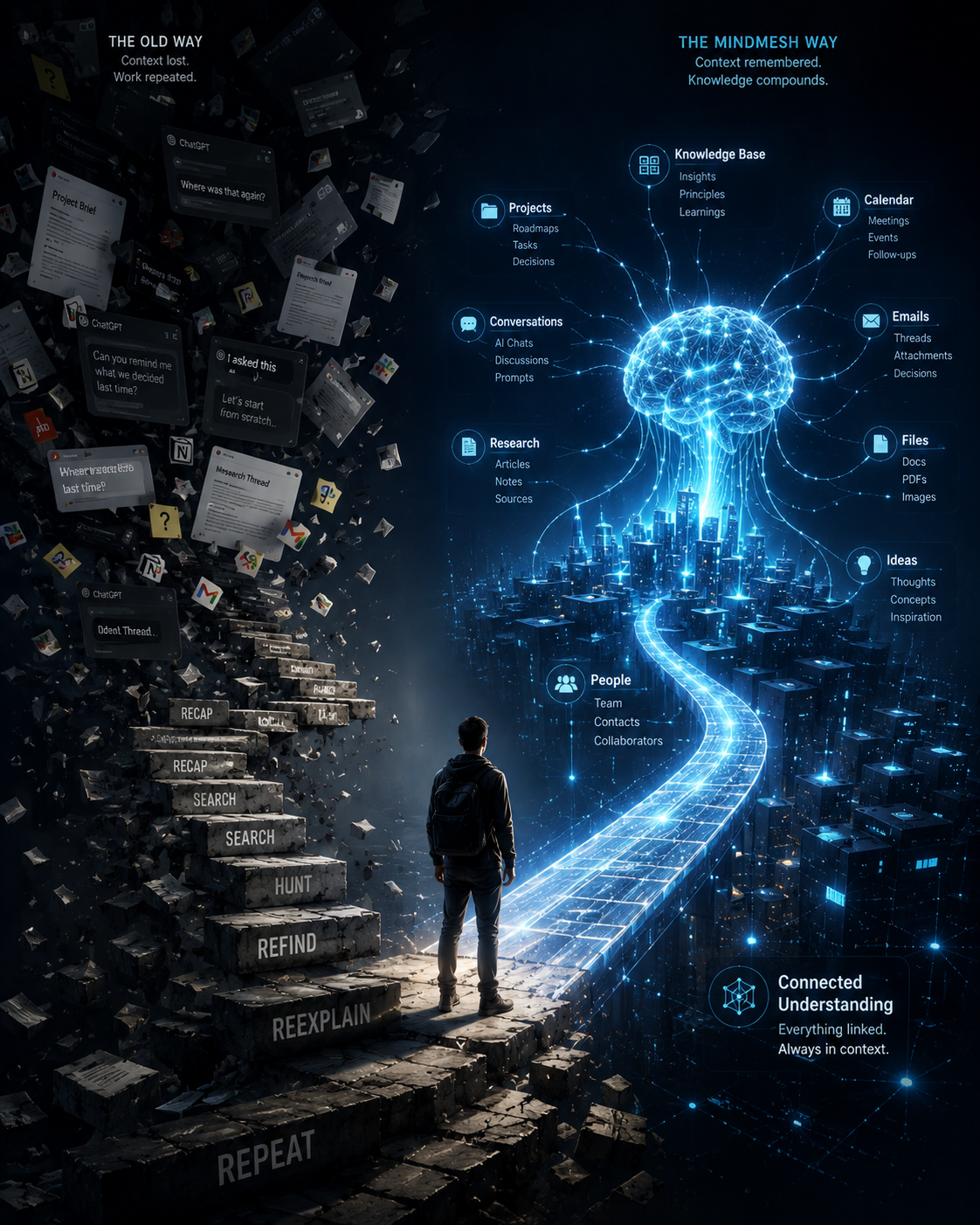
AI is starting to feel personal. That doesn’t mean it understands your actual life.
There’s a strange moment happening in AI right now.
Your tools are getting better at remembering *you*. They know your tone. Your favorite format. Maybe your role, your company, your recurring interests, the kinds of emails you write, the way you like ideas summarized. The experience feels smoother. Less cold. Less like starting from zero.
And yet the real work still falls apart.
Your AI might remember that you’re a founder who likes concise writing and strategic framing. But when you open a session to continue a product launch, it still doesn’t reliably know which decision got made on Tuesday, which research source changed your thinking on Wednesday, what your designer flagged on Thursday, or why that “quick experiment” is now tied to three other priorities.
That gap matters more than most people realize.
Because the real promise of AI was never just personalization. It was continuity. It was the hope that our tools could actually carry thinking forward instead of making us rebuild it every time.
That’s the line the market is finally approaching. And it’s a useful one to understand:
AI that remembers you is not the same thing as AI that remembers your work.
The market is racing toward memory, but “memory” means two different things
If you’ve been paying attention to the broader AI industry, this shift is everywhere.
OpenAI has pushed harder into memory and more persistent user context. Google keeps moving Workspace and NotebookLM toward agentic assistance grounded in documents, research, and work artifacts. Notion is leaning further into AI orchestration inside an existing work environment. Anthropic, Gemini, ChatGPT, and a growing field of AI companies are all circling the same idea from different angles: AI becomes more useful when it stops acting like every interaction is brand new.
That part is true.
But “memory” has quietly become an umbrella word for two very different capabilities.
Type one: AI remembers the person This is identity memory.
It includes things like: - your preferences - your writing style - your role - your recurring goals - personal details you’ve shared - how you like information presented
This kind of memory is helpful. It reduces friction. It makes AI feel less generic.
Type two: AI remembers the work This is operational memory.
It includes things like: - project history - prior decisions - source material - unfinished threads - dependencies - connected notes - tasks and follow-ups - research that shaped the current plan - the relationship between one conversation and another
This kind of memory changes whether work can actually move forward.
And most people don’t realize they’ve been settling for the first while needing the second.
Why this distinction feels small in theory but huge in real life
On paper, the difference sounds almost philosophical.
In practice, it’s the difference between feeling supported and feeling mentally exhausted.
Let’s say you’re running a small company. You’ve got a hiring thread in email, product feedback in Slack, strategy notes in a doc, customer objections in a voice memo, and two useful AI conversations spread across different tabs from earlier in the week.
Now it’s Friday. You finally have 45 minutes to make a real decision.
An AI that remembers *you* might say: “You prefer bullet points, founder-first framing, and concise summaries.”
Nice. Helpful, even.
But an AI that remembers *your work* would know: - the product objection from a customer call connects to the roadmap note from Tuesday - the hiring delay affects the launch timeline - the research summary you saved last week already answered half of today’s question - you previously rejected one option because of cost, not quality - there’s an unfinished follow-up sitting in your notes that should change the recommendation
That is a completely different level of usefulness.
One is personalization.
The other is continuity.
The hidden cost isn’t forgetting facts. It’s losing momentum.
People often talk about AI memory as if the main problem is forgetting information.
But for founders, operators, creators, and busy professionals, the real pain is usually not, “My tool forgot a fact.”
It’s more like: - “Why am I briefing this thing again?” - “I know I already thought this through somewhere.” - “I had a good conversation about this, but now I can’t connect it back to the project.” - “The answer was useful in the moment, but it never became part of my system.” - “Everything important is scattered, and every day feels like recovery.”
That last one is the killer.
When your work has no central home, you burn energy reconstructing your own thinking. You search old chats. You skim docs. You open five apps. You piece together what you meant, what changed, what still matters. You become the integration layer between disconnected tools.
That’s not just annoying. It’s cognitively expensive.
It’s why people can be surrounded by “smart” tools and still feel mentally overloaded all the time.
This is also why the idea behind [MindMesh](https://mindmeshapp.com) lands differently for a certain kind of person. Not as another app. Not as another place to dump information. But as a cognitive workspace built around a simple belief:
Your thoughts deserve a better home.
Because if your notes live in one place, your AI chats in another, your tasks somewhere else, and the logic behind your decisions nowhere at all, then your work doesn’t actually have memory. It has fragments.
What work memory actually looks like
Real work memory is not just a chat app with a longer recall window.
It’s a system that can hold the living context around what you’re doing.
It remembers decisions, not just discussions A lot of AI tools are good at generating possibilities. Fewer are good at preserving the outcome.
For example, maybe you spent an hour using AI to think through pricing. The conversation was great. By the end, you had a real decision: hold the annual plan, test a new onboarding offer, and revisit packaging after the next cohort of users.
Three days later, the useful part is not that you once had a pricing conversation.
The useful part is that the decision exists, can be retrieved, and can be linked back to the evidence that produced it.
It connects source material to execution Research is often where good ideas go to disappear.
You read articles. Save screenshots. Ask AI to summarize transcripts. Drop half-formed thoughts into notes. Then when it’s time to act, none of that context is connected to the actual project.
Work memory closes that gap.
Instead of “research over here, execution over there,” the system can carry the thread forward.
In MindMesh, that can look like capturing raw notes, documents, chats, and follow-ups in one connected environment, then using Nova to retrieve the thread by meaning when you need it. Not because you tagged everything perfectly, but because the system understands the relationship between the pieces.
It helps you resume without rebuilding This might be the most underrated capability of all.
Good work rarely happens in one sitting. You start something, get interrupted, switch contexts, take a call, answer messages, come back later, then try to remember where your brain was.
A true AI memory workspace should make resuming easier than restarting.
That means when you come back to a project, you can recover: - what you were doing - what mattered most - what was decided - what still needs to happen - what prior material is relevant now
Not after 20 minutes of searching. Immediately.
A founder example: the strategy thread that broke across six tools
This is the kind of problem that sounds dramatic until you’ve lived it.
A founder starts the week with a loose question: should we reposition a product around a stronger pain point?
They collect notes from customer calls. Ask an AI model to pull themes from transcripts. Save a few smart thoughts in a notes app. Draft messaging ideas in a document. Message a teammate. Add a few action items to a task manager. Then have another AI conversation about positioning language.
Nothing went wrong, exactly.
But by the end of the week, the work is spread everywhere: - raw input in one tool - interpretation in another - draft language in another - task implications in another - and the actual strategic throughline nowhere visible in full
Now the founder wants to continue.
This is where most AI still fails. It may remember the founder likes sharp messaging and concise summaries. It may even know the company name.
But it does not reliably remember the work as a connected whole.
A cognitive workspace should.
Inside MindMesh, that same thread can live as connected context: captures from calls, notes, chat outputs, tasks, and evolving project reasoning in one environment. Nova can then surface the earlier transcript pattern, the draft message, the unresolved objection, and the next action together when the founder asks a natural question like, “What was our strongest repositioning direction from last week, and what still needs validation?”
That is what remembering work feels like.
Not magic. Just continuity.
Why personalization alone won’t solve mental overload
There’s a reason so many people still feel scattered even as AI gets more polished.
Because polished is not the same as grounded.
An assistant that knows your tone can still leave you drowning in disconnected context. A tool that remembers your preferences can still make you reconstruct the actual state of your projects from scratch. A better interface can still hide the deeper problem: your thinking has no durable operating environment.
This is the part a lot of note-taking apps, chat apps, and even some AI workspaces miss.
People don’t just need a place to store things.
They need a place where thinking can keep its shape.
That means: - ideas don’t vanish after one useful session - notes don’t become dead archives - decisions stay attached to the work they affect - AI conversations become reusable context instead of disposable output - your life and work stop feeling like a pile of open loops
That’s also why “more apps” rarely fixes the feeling of overload. Usually it just creates more edges where context can fall through.
What a cognitive workspace remembers that ordinary tools often don’t
A traditional note app stores information.
A chat app generates responses.
A task manager tracks to-dos.
A document tool helps produce output.
All useful. None of them, on their own, are designed to hold the full continuity of work.
A cognitive workspace is different because it’s built around relationships, retrieval, and connected context.
In plain English, that means it can help you answer questions like: - What did we already decide about this? - Where did this idea come from? - Which old note matters right now? - What was I working on before I got interrupted? - Which conversations, documents, and tasks belong to the same project? - What am I forgetting that I already captured?
That is where an AI memory workspace starts to feel less like a feature set and more like relief.
With MindMesh, the practical difference is not just that information lives together. It’s that Nova can retrieve across notes, emails, captures, lists, and project materials by context and meaning. A note from three months ago can become relevant again because it’s connected to today’s decision. A scattered set of inputs can become one recoverable thread.
For people whose thoughts are always arriving mid-walk, mid-meeting, mid-tab-switch, that matters a lot.
The next standard for useful AI is not familiarity. It’s carry-forward power.
We’re heading into a phase where more AI products will claim memory. Many of them will be telling the truth.
But readers, buyers, and teams should get more specific about what they’re asking for.
The important question is not: Does this AI remember me?
The more important question is: Can this AI remember the work well enough to continue it?
Can it carry forward decisions?
Can it connect today’s question to last month’s research?
Can it surface the unfinished thread you forgot about?
Can it help you resume without rebuilding the whole scaffolding in your head?
Can it turn scattered captures into continuity instead of clutter?
That’s the standard that actually changes how people work.
And it’s the standard more people are going to demand as the novelty of “smart answers” wears off. Answers are abundant now. What’s still rare is preserved context that stays useful over time.
Your thoughts need more than storage. They need a home.
This is really the heart of it.
Most people are not struggling because they lack information. They’re struggling because their information, decisions, and thinking are homeless. A little bit here, a little bit there, useful in the moment, hard to recover later.
That’s exhausting.
It makes smart people feel disorganized. It makes creative people feel blocked. It makes founders feel like they are constantly re-briefing both their tools and themselves.
The future of working with machines will belong to systems that don’t just flatter us with personalization, but actually support the continuity of real life and real work.
That’s the lane MindMesh is building in, and it’s why the category matters. Not as a trend label, but as a practical shift in how we live with our tools.
If you’ve been feeling like your ideas are scattered across too many places, that your AI helps in bursts but never truly carries anything forward, or that your work and life still have no central home, this is the shift to pay attention to.
Because there is a difference between AI that remembers *you* and AI that remembers *your work*.
And once you feel that difference, it’s hard to go back.
If you want to explore more stories like this, visit [MindMesh Magazine](https://resources.mindmeshapp.com/magazine). If you’re ready to see what a connected cognitive workspace feels like in practice, start with [MindMesh](https://mindmeshapp.com) or browse more tools, frameworks, and field notes in the [resources library](https://resources.mindmeshapp.com/resources).
Your thoughts deserve a better home.
Turn scattered context into a workspace that helps you think, organize, and move.
Explore AI Models