The Context Trap: Why Faster AI Models Are Making Knowledge Work More Fragmented (and How to Fix It)
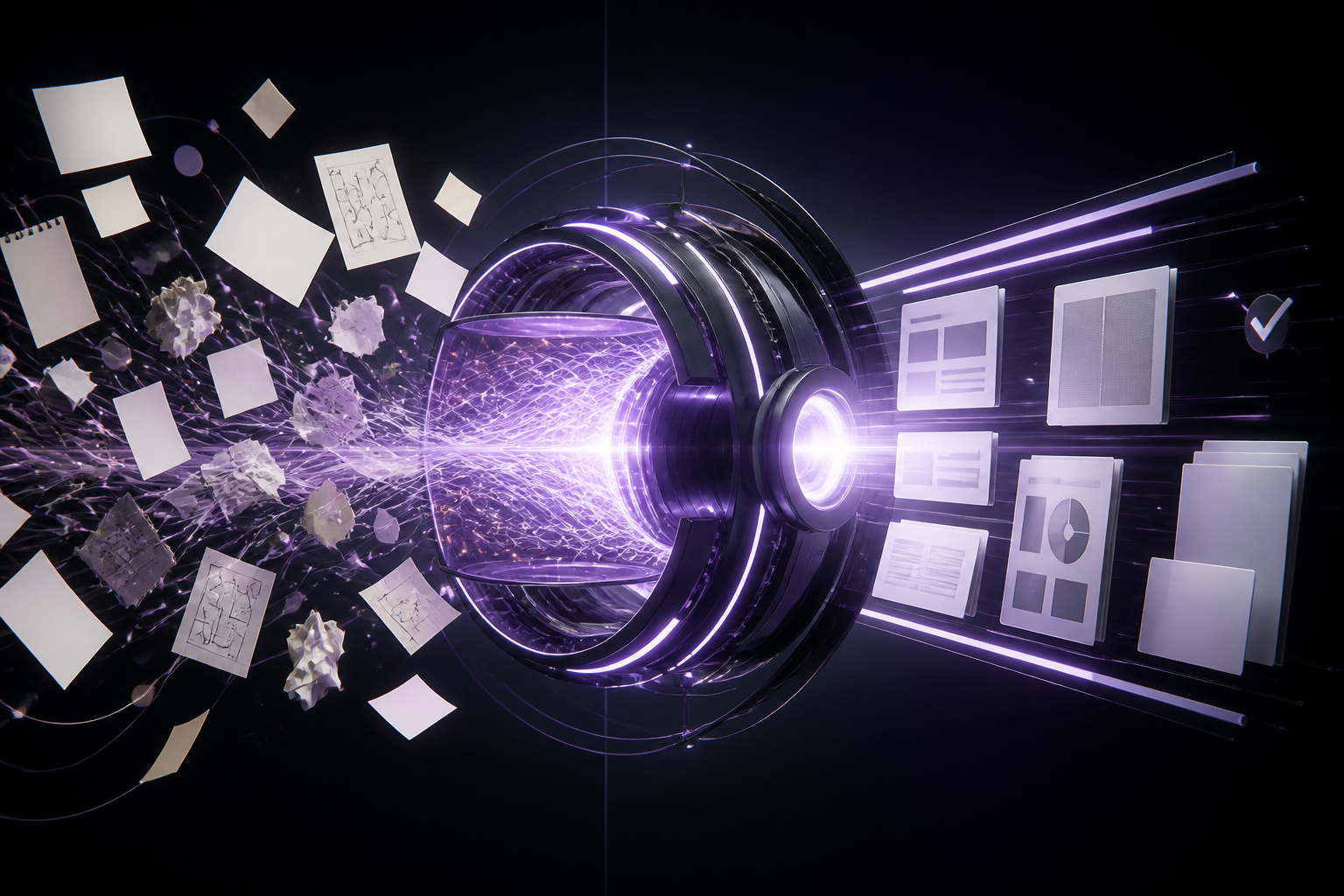
The Context Trap: Why Faster AI Models Are Making Knowledge Work More Fragmented (and How to Fix It) It is 4:15 PM on a Tuesday afternoon. Your browser bar is a dense accordion of thirty-two open tabs. Over the last six...
It is 4:15 PM on a Tuesday afternoon. Your browser bar is a dense accordion of thirty-two open tabs. Over the last six hours, you have bounced between three video calls, reviewed a live design doc, answered a dozen messages across slack channels, and opened four separate AI chat windows to summarize transcripts, draft client emails, and pull quick research points.
On paper, it has been a hyper-productive day. You generated thousands of words of analysis in minutes. You asked a model to break down a complex quarterly report while you grabbed coffee. You ran a quick prompt to draft three distinct positioning statements for a product launch.
Yet, as you sit back to close out your afternoon, a cold, familiar fatigue sets in. You need to pull together the final action plan for tomorrow morning's leadership team meeting, and you hit a wall. Where did that key takeaway from the 11:00 AM call actually go? Which chat window contained the revised budget calculation? Was the approved messaging stored in the shared drive, pasted into a comment thread, or left in an ephemeral prompt history?
You aren't underperforming; you are drowning in disconnected velocity.
This daily friction points to a fundamental reality of the modern workplace: as AI models become infinitely faster, cheaper, and more ubiquitous, raw generation speed is no longer the bottleneck in knowledge work—context preservation is.
When every tool gives you instant answers, the central challenge of modern work shifts from how fast can we produce information to how efficiently can we retain, connect, and act on context. Without a permanent system to anchor our thinking, faster tools simply create faster clutter, trapping knowledge workers in a constant state of cognitive reset.
---
The Acceleration Paradox: Faster Models, Disconnected Work
To understand how we arrived at this context crisis, we only need to look at the rapid evolution of the underlying technology over the past year.
In March 2026, OpenAI introduced its GPT-5.4 mini and nano models, explicitly engineered for lower latency, reduced cost, and high-volume background subagent execution. Around the same time, Microsoft expanded its Copilot architecture with Copilot Tasks and Agent 365, designed to let automated agents execute micro-tasks across enterprise applications. By late spring, Google revealed Gemini 3.5 Flash at Google I/O 2026, pushing agent-first tooling directly into everyday search and workspace surfaces, only to follow it up in August with Gemini 3.7 Flash.
The market message is unambiguous: AI is moving from a destination you visit (a chat window) to an invisible infrastructure layer that runs everywhere, all the time. Subagents are now cheap enough to analyze spreadsheets while you sleep, draft email options while you type, and synthesize meeting notes before you even leave the call.
``` +-----------------------------------------------------------------------+ | THE ACCELERATION PARADOX | | | | [ Faster, Cheaper Models ] ---> [ 10x Velocity of AI Artifacts ] | | | | | v | | [ Fragmented Context & Mental Fatigue ] <--- [ Context-Switching ] | +-----------------------------------------------------------------------+ ```
This rapid acceleration reveals a profound operational paradox: the cheaper and faster model outputs become, the higher the cognitive tax on the human being required to coordinate them.
When drafting an executive briefing took four hours of manual synthesis, the writer held the entire logical architecture in their head. The process was slow, but the context was unified. Today, a professional can generate four competing versions of that same briefing in forty seconds across three different AI applications. But because those outputs exist as isolated artifacts—trapped inside disposable browser tabs, disparate chat logs, and unlinked documents—the human operator must act as a manual air traffic controller.
Instead of spending energy on deep synthesis, strategic decisions, and high-level problem solving, knowledge workers spend their best mental energy copying text between tabs, re-explaining project background to different tools, and hunting down lost decisions across a dozen application silos.
---
The Hidden Cost of the "Chat History Graveyard"
Why are conventional AI tools failing to solve this problem? The issue is structural.
Most AI applications are designed around the linear, disposable paradigm of the chat box. You open a prompt window, paste in a chunk of text, ask a question, get an answer, copy the result into a document, and close the tab or move on to a new topic.
This chat-first architecture treats human thought as a series of isolated, disposable transactions. It assumes that once a conversation ends, its value is exhausted.
``` DISPOSABLE CHAT ARCHITECTURE: [Prompt] -> [Output] -> [Copy/Paste] -> [Closed Tab] = Context Lost Forever
CONNECTED COGNITIVE ARCHITECTURE: [Idea / Note / Chat] ---> ( Automatic Context Linkage ) ---> [Permanent Knowledge Hub] ```
In reality, professional work is continuous and non-linear. A strategy decision made in a Tuesday morning brainstorming session directly impacts a client presentation three weeks later, which in turn influences a quarterly hiring plan two months down the line.
When your primary workplace interface relies on disposable chat sessions, several structural problems emerge:
1. Context Loss at Scale: Every new conversation starts from a blank slate. You are forced to re-upload files, re-paste guidelines, and re-explain institutional background to an assistant that forgets everything the moment a thread is archived. 2. Knowledge Silos: The brilliant insight generated in a standalone session remains locked inside that specific interface. It never intersects with your team's project notes, your client CRM records, or your personal task list. 3. Severe Cognitive Overload: The human brain is not built to remember which specific app, thread, or account held a half-formed idea. When information is scattered across fragmented systems, mental anxiety rises as professionals worry about dropped balls and forgotten details.
This friction is precisely why modern knowledge workers, founders, and operators feel increasingly exhausted despite having access to the most powerful computational tools in human history. We are swimming in intelligence, but starving for coherence.
---
Shift from Fragmented Tools to a Permanent Cognitive Workspace
If faster models and infinite chat tabs are not the solution, what is? The answer lies in shifting our perspective on what AI tools are meant to do.
We do not need more standalone chatbots that answer questions in a vacuum. We need an intelligent workspace that serves as a permanent, living memory engine—a central hub where conversations, ideas, research, meeting notes, and execution steps continuously inform one another.
This is the shift from transactional utilities to a unified cognitive workspace. Instead of viewing AI as a temporary search box, forward-thinking professionals use platform environments like MindMesh's AI cognitive workspace to capture background context, link related insights across projects, and transform transient notes into a structured, growing knowledge base.
When your workspace automatically remembers the relationships between your ideas, several key transformations happen in your daily rhythm:
Conversations Become Permanent Assets: A brief voice note recorded while walking between meetings or a quick brainstorming prompt doesn't fade into an unstructured history log. It immediately connects to the relevant project, surfacing historical context when you start your next deliverable. Reduction of Manual Organization: Rather than forcing you to spend fifteen minutes filing documents into nested folder hierarchies, an intelligent workspace understands semantic relationships, surfacing the right reference document exactly when you need it. * Proactive Context Retrieval: Instead of forcing you to hunt down background details, your assistant understands the broader canvas of your work—remembering client preferences, project history, and strategic goals across every interaction.
``` +---------------------------------------------------------------------------------+ | TRANSACTIONAL VS. CONNECTED WORK | +----------------------------------+----------------------------------------------+ | Transactional AI (Legacy) | Connected Cognitive Engine (Modern) | +----------------------------------+----------------------------------------------+ | Ephemeral prompt sessions | Living, compounding memory environment | | Isolated, single-use outputs | Interconnected notes, tasks, and documents | | Manual copy-pasting between apps | Native integration across workflow surfaces | | Constant re-explaining of context| Automatic context preservation over time | +----------------------------------+----------------------------------------------+ ```
---
A Real-World Scenario: The Multi-Project Operator
Consider how this plays out in the daily life of a managing director or startup founder named Sarah.
Sarah is balancing three active client engagements, a funding round, and an internal hiring push. On a traditional stack, her workflow is intensely fractured:
She takes raw notes during a candidate interview in a desktop note app. She uses an external AI tool to draft a follow-up email to an investor. She reviews client feedback inside a shared document editor. She tracks team deliverables in a separate project board.
By 3:00 PM, Sarah has executed twenty distinct tasks, but her operational context is scattered across four different databases and half a dozen browser tabs. When an investor calls unexpectedly to ask how the hiring pipeline intersects with their financial projections, Sarah spent five frantic minutes opening tabs, searching message histories, and trying to reconcile separate pieces of information.
Now contrast this with an environment designed around permanent context:
When Sarah conducts her candidate interview, her notes live in a central space alongside her company's strategic goals and financial targets. When she prompts her workspace assistant to draft an investor update, the system automatically draws from the recent interview highlights, the updated quarterly projections, and previous client communication.
She doesn't have to re-explain who the key hires are or paste historical metrics into a fresh chat bar. The system holds the complete narrative context of her business, allowing her to move from thought to execution without friction.
---
Four Principles for Building a Frictionless Knowledge System
If you want to escape the context trap and build a sustainable operating structure for your work, adopt these four core principles:
1. Stop Treating Chat as a Destination
Treating an AI conversation as a isolated destination is the fastest route to context fragmentation. Shift your mindset: every chat, prompt, or quick query should take place inside the environment where your core work actually lives. If a quick prompt produces a valuable outline or decision, anchor that output immediately to a permanent document, task, or project board.
2. Prioritize System Continuity Over Model Upgrades
It is tempting to get caught up in benchmark wars—debating whether a new release is 3% faster at reasoning or slightly better at code generation than its predecessor. But for 95% of daily knowledge work, model intelligence is already more than sufficient. The true force multiplier is system continuity. A slightly older model working with perfect, complete context will outperform the world's fast frontier model working with zero context every single time.
3. Build for Compounding Context
Evaluate your tool stack by asking a simple question: Does using this tool today make my work easier tomorrow? If an application leaves your research locked in an unindexed silo, it is generating technical debt. Choose tools that automatically preserve context, build links between related thoughts, and allow your institutional knowledge to compound over time. To explore detailed strategies on building structured knowledge systems, explore the guides available at the MindMesh Resource Hub.
4. Protect Human Working Memory
Your brain is designed to cultivate insights, recognize complex patterns, and make strategic decisions—not to function as a temporary storage drive for browser tab URLs, action items, and unorganized meeting quotes. Offload the burden of administrative recall to an intelligent workspace that captures, organizes, and retrieves context automatically.
---
The Future Belongs to the Connected
The technology landscape will continue its rapid evolution. We will see even smaller, faster, and cheaper models arrive alongside increasingly autonomous subagent frameworks capable of executing hundreds of micro-actions per minute.
``` +---------------------------------------------------------------------+ | THE FUTURE OF KNOWLEDGE WORK | | | | RAW MODEL SPEED + PERMANENT CONNECTED CONTEXT | | (Commoditized Foundation) (Durable Competitive Advantage)| +---------------------------------------------------------------------+ ```
But model speed is merely electricity; connected context is the engine. As raw generation becomes fully commoditized, the personal and professional advantage will not belong to those who can generate the most text the fastest. It will belong to the founders, leaders, creators, and operators who maintain total clarity over their knowledge, decisions, and momentum.
By moving away from disposable chat interfaces and establishing a permanent, connected cognitive workspace, you eliminate the mental fatigue of constant context-switching. You give your ideas a lasting home where they can evolve, connect, and translate into clear action—turning daily information noise into a compounding strategic asset.
---
To read more articles on building modern workflows, personal operating systems, and intelligent workspaces, visit MindMesh Magazine.
---
The value of artificial intelligence is not measured by how fast it answers a question, but by how permanently it preserves the context of your work.