The AI Workspace War Is Here. Your Context Is the Prize
The AI Workspace War Is Here. Your Context Is the Prize Google’s merger of NotebookLM and Gemini is a market flare, not just a product update. It proves that AI work is moving from chat windows into full workspaces, but...
Google’s merger of NotebookLM and Gemini is a market flare, not just a product update. It proves that AI work is moving from chat windows into full workspaces, but founders should be cautious about trading scattered tools for a single locked-in memory silo. The real advantage belongs to people who build a cross-tool operating system for their ideas, decisions, tasks, and momentum.
The fight is no longer about which chatbot answers fastest. It is about who holds the working memory of your life.
For years, the obvious question was: which AI model should I use? Founders compared responses, operators tested prompts, and creators debated whether one assistant wrote better copy while another reasoned more deeply. The conversation became a rolling set of tool comparisons: OpenAI versus Anthropic versus Gemini, chat window versus chat window.
That was useful for a while, but it missed the bigger shift. The next wave is not just smarter AI models; it is persistent AI workspaces. These are environments where your notes, files, research, plans, and conversations sit close enough to the assistant that it starts to feel less like a question-answering machine and more like an extension of your own mind.
The promise is seductive. Put your documents here. Let the AI remember. Search across the mess. Keep the thread alive. Anyone who has spent a Monday morning reconstructing their own brain from Slack, email, Notion, Jira, Google Docs, calendar notes, screenshots, and a half-remembered voice memo can understand the appeal. The modern workspace is not one place; it is a debris field.
The risk, however, is that the industry solves fragmentation by building a bigger container. A bigger container helps, but a container is not the same thing as control.
---
The Mirage of the Monolithic Memory
A founder’s real context is rarely neat enough to live inside one ecosystem. When a single vendor promises to be the home for all your thinking, they are selling an illusion of simplicity. They want you to believe that if you migrate enough of your life into their database, the friction of work will disappear.
But work refuses to stay put.
Consider a typical Tuesday morning for a startup founder. Her engineering team is migrating a core database. The critical decision was based on a benchmark shared in a private Slack DM, a pricing sheet in Google Sheets, and an architecture diagram sketched in Miro. Two months later, a new engineer asks why they are not using a different database architecture.
The context is gone.
The decision technically exists somewhere. The pricing sheet is still in Drive. The benchmark may still be buried in Slack. The Miro board may still exist under a vague project name. But the thread that connected those pieces—the why, the trade-offs, the pressure at the time, the constraint that made the choice obvious—is no longer available in one place.
If the team’s AI workspace can only remember what lives inside its own walls, it cannot reconstruct the real decision. It cannot see the Slack DM where the CTO explained the technical constraint. It cannot access the Miro board where the trade-offs were visualized. It may confidently summarize the documents it can reach while missing the reason the decision was made.
A silo with AI memory is still a silo. It may be smarter, smoother, and more pleasant than the old mess, but if it cannot follow your context across the places where work actually happens, it becomes another room you have to keep updated. You do not escape context management; you simply become the person responsible for feeding the new memory machine.
---
The Invisible Tax of the Digital Debris Field
Context fragmentation is not just an operations problem; it is an energy problem. When your work is scattered, your day fills with invisible rework. You reread threads, search for files, ask colleagues to resend links, and rewrite the same summaries. You make decisions with partial memory and then spend the afternoon wondering what you missed.
The damage is not dramatic at first. It is not one catastrophic failure. It is the slow leak of momentum.
Take the example of David, a customer success lead triaging an enterprise account at risk of churning. The warning signs were everywhere: an angry email thread about a recurring bug, a Jira ticket marked low-priority by engineering, and a brief, frustrated mention during a Zoom call. Because those signals lived in separate tools, David walked into the renewal conversation without the full picture.
The account did not churn because the team did not care. It churned because the context was trapped in separate software architectures.
Or consider the founder who hears a critical customer insight in a chaotic Slack thread. A frustrated user says the product is not failing because of missing features; it is failing because onboarding makes the team feel exposed in front of their colleagues. That is gold. It changes the product story, the sales motion, and the roadmap.
But the thread keeps moving. Someone drops a bug report. Someone else tags support. The founder reacts with a quick emoji and moves to the next fire. Two weeks later, the team debates why activation is weak. Nobody remembers the exact wording of the customer’s insight. The information is technically saved somewhere, but practically gone.
The company did not lose the data. It lost access to the context at the moment it mattered most.
This is the daily tax of scattered context: repeated decisions, forgotten commitments, emotional drag, and slower movement. The founder feels it as stress, the team feels it as churn, and the business feels it as delay.
---
The Battleground Is Cognitive Continuity
The phrase “AI memory” can sound technical, like a feature tucked into a product release note. For leaders and creators, it is strategic. Memory determines what your organization can carry forward.
If your tools remember only isolated objects, your work becomes object-shaped: documents, tickets, messages, tasks. If your system remembers relationships, your work becomes decision-shaped: why this mattered, who cared, what changed, and what should happen next.
Traditional productivity tools are excellent at storing things, but they are terrible at preserving the thread between things. That thread is where judgment lives.
```text Raw inputs: Slack, email, docs ↓ The missing thread: context and logic ↓ Actionable momentum ```
Cognitive workspaces are emerging because the old model broke under the weight of modern work. The average knowledge worker no longer has a single desk, a single inbox, or a single project board. Their mind is stretched across apps. The workspace has become psychological as much as digital.
The danger is assuming the answer is simply to choose the most powerful vendor and move your brain into its house. When one company owns your workspace, your AI memory, your search layer, and your working archive, convenience and dependence arrive together.
A single-vendor memory reduces friction inside that vendor’s world. A cross-tool operating system reduces friction across your world.
Those are not the same promise.
---
Build a Nervous System, Not a Warehouse
A cross-tool personal operating system does not mean another bloated dashboard. It means a simple discipline: your ideas, decisions, tasks, and follow-ups must survive the journey between tools.
When a customer insight appears in Slack, it should not die in Slack. When a meeting creates a decision, that decision should not depend on someone remembering which document contains the notes. When a task emerges from a call, it should not float around as a vague intention until the next crisis knocks it away.
Think of it as the difference between a warehouse and a nervous system. A warehouse stores things. A nervous system senses, routes, prioritizes, and reacts. Most professionals do not need a larger warehouse. They need a better nervous system for their work.
That system can be simple, but it must answer four questions.
1. What did I capture?
Capture must be frictionless. If you have to open a specific app, navigate to a project folder, and format a note just to save an idea, you will not do it. Capture should happen where you are, the moment the thought occurs.
A lawyer leaving a client call should be able to save the one line that changes the case strategy. A teacher should be able to capture the moment a lesson finally clicks for students. A founder should be able to preserve the customer sentence that explains the real product problem.
2. What does it mean?
Raw inputs are noisy. A link to an article is useless without a note explaining why you saved it. A screenshot of a competitor’s pricing is meaningless without your analysis of how it affects your positioning.
Meaning is the difference between “saved” and “usable.”
3. Where does it belong?
Information needs a home determined by its utility, not its format. A decision about product strategy belongs with the product roadmap, even if that decision was made in a Slack thread. A hiring insight belongs with the candidate or team plan, even if it came from a hallway conversation. A market signal belongs with the strategy it might change.
Your tools should support the way your work connects, not trap each item inside the place it first appeared.
4. What should happen next?
Every piece of critical context should point toward action. If a note does not lead to a task, a decision, a reminder, or a reference point for a future project, it is just digital clutter.
The mistake is stopping at capture. We capture constantly: saving articles, bookmarking threads, taking screenshots, opening tabs, forwarding emails to ourselves. Capture is no longer the bottleneck. Synthesis is.
---
Design for the Human Mind Under Pressure
The best systems respect the reality of human behavior. You will not capture everything perfectly. Your team will keep using different tools. Important information will arrive at inconvenient times. The best ideas will not always appear while you are sitting inside the “right” app.
That means your system has to be forgiving. It has to work when you are tired, rushed, distracted, or moving between meetings. It has to preserve enough context that your future self can recover the thread without performing a digital excavation.
Start by identifying the recurring forms of context your work depends on. For most professionals, they fall into five groups:
- Ideas worth revisiting: the raw material for future projects, articles, products, or strategies. - Decisions worth remembering: the “why” behind your choices, preserved so you do not have to relitigate them. - Tasks worth doing: action items with clear owners, deadlines, and context. - People worth following up with: relationships that require consistent, contextual communication. - Signals worth connecting: trends, customer feedback, and market changes that shape your direction.
If your system can handle those five, you are ahead of most teams.
This is where many productivity systems fail. They treat everything as either a note or a task. But professional life is messier than that. A customer complaint is not just a note; it is a product signal, a sales risk, and a messaging opportunity. An investor’s question is not just an email; it reveals a weakness in your company narrative. A student’s confusion is not just classroom friction; it may reveal that the entire lesson sequence needs to change.
The operating system has to preserve this richness without demanding too much ceremony. If it requires thirty seconds of effort, it might survive. If it requires five minutes of filing, tagging, and formatting, it will become another abandoned temple to your better self.
Here is a practical test: can you return to a project after ten days away and understand its real state within five minutes?
Not the official status report. The actual state.
What changed? What are we waiting on? What did we decide? What are we avoiding? If the answer requires searching four tools and bothering three colleagues, your system is not carrying context. Your people are.
That does not scale, and it creates the low-grade anxiety of knowing that something important is probably lost in the cracks.
---
Reclaim Sovereignty Over Your Ideas
The AI workspace war will be framed as a competition between platforms. The tech giants will battle over who has the most powerful assistant, the deepest integrations, or the most comprehensive search layer. The demos will look impressive. The integrations will get tighter. The promise will be that if you bring more of your work into one place, your work will finally feel under control.
Those questions matter, but they are not the deepest question for the person trying to build a company, write a book, manage a team, run a practice, or simply live with less mental clutter.
The deeper question is: who controls the continuity of your thinking?
If your memory lives entirely inside one vendor’s workspace, your future self depends on that vendor staying aligned with your needs. If your context is scattered across disconnected tools, your future self depends on heroic recall. Neither is ideal.
The better path is to build a layer of ownership around your own working life. Use powerful AI workspaces. Learn from them. Let them reduce friction where they can. But do not confuse a platform’s memory with your own operating system.
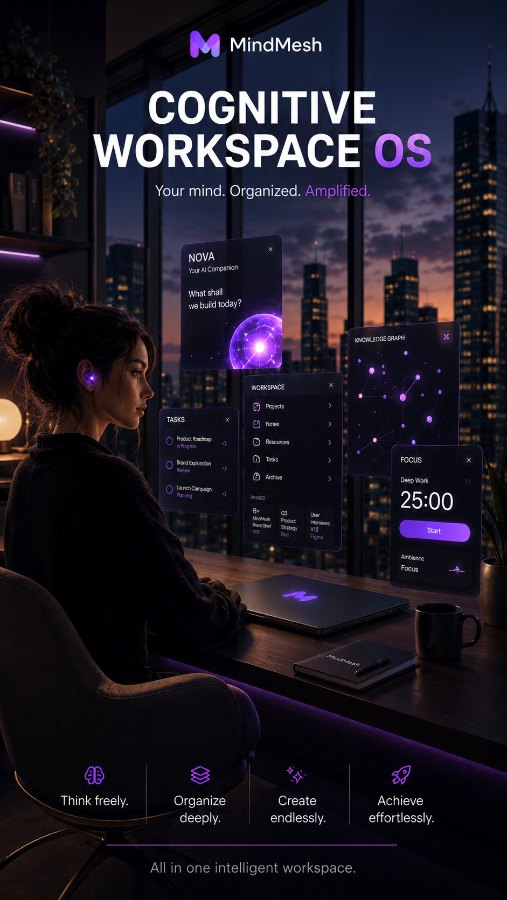
When an idea is worth keeping, MindMesh gives you a place to capture it, organize it, and turn it into action. For more thinking on cognitive workspaces, AI memory, workflows, and founder systems, explore MindMesh Magazine.
The winners of the AI workspace war will not be the people who surrender the most context to one platform. They will be the people who keep their context portable, connected, and alive.