The AI Race Nobody Is Winning
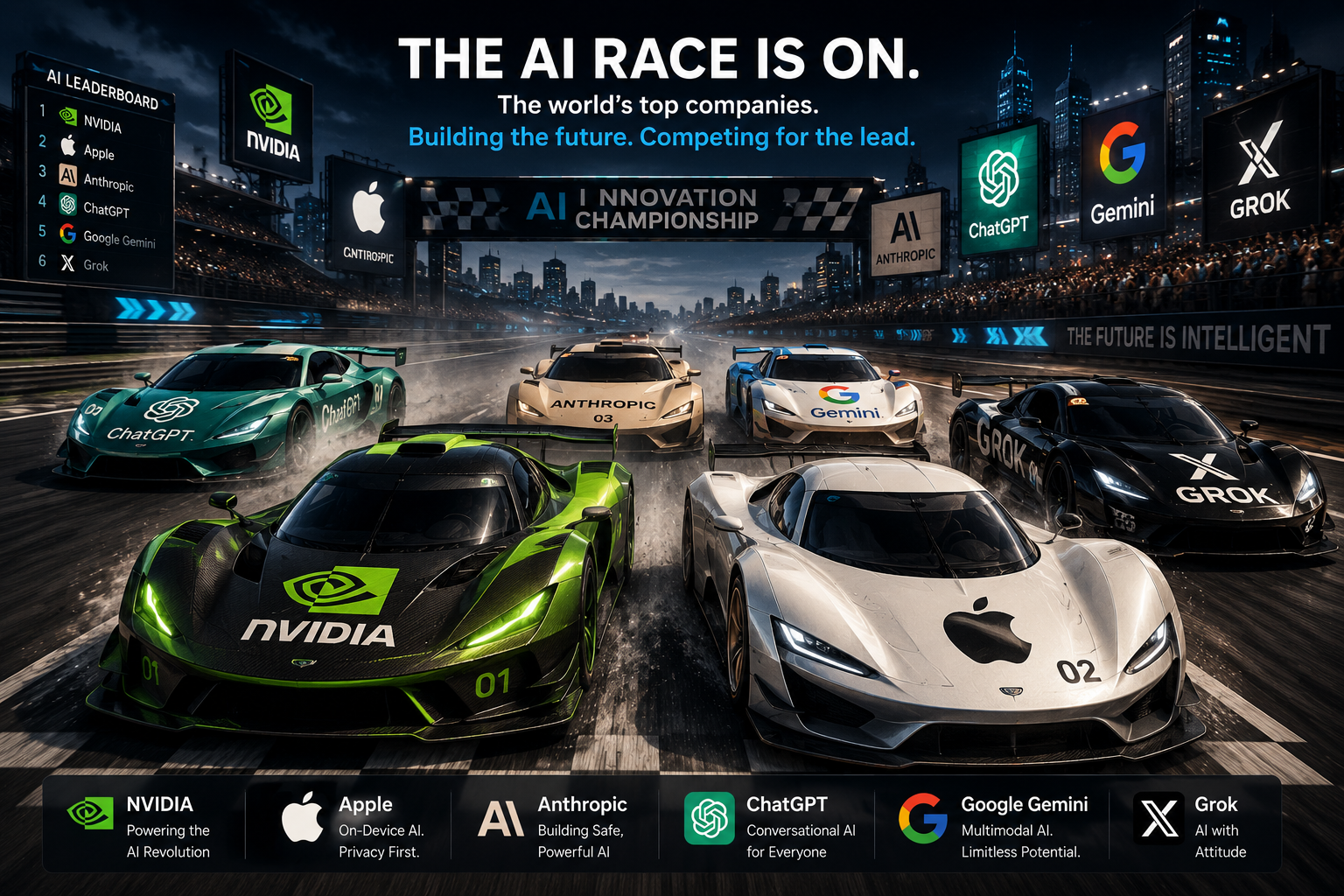
A leaderboard makes the AI race look simple. The real contest is messier: chips, enterprise revenue, distribution, devices, and market stories are all running at once.
Six sports cars line up at a checkered flag, each running a different tech company's colors, with a leaderboard ranking them one through six like a videogame standings screen: Nvidia, Apple, Anthropic, ChatGPT, Gemini, Grok. It's a tidy image. It's also already wrong. By the time anyone could print that ranking, Anthropic had passed OpenAI in private-market value, Apple had handed its most important software project to a rival, and the company sitting in last place had just helped its parent firm pull off the largest IPO in history. The grid keeps repainting itself mid-lap.
That's worth sitting with, because most coverage of "the AI race" still borrows its vocabulary from motorsport: pole positions, leaderboards, a clean winner crossing an obvious finish line. The problem is that nobody racing has agreed on where the finish line is. Big technology companies spent more than $400 billion on AI infrastructure in 2025 and are on pace to spend over $600 billion more this year, and that money is chasing several different prizes at once: the most users, the most reliable enterprise revenue, the most defensible technology, or simply a story compelling enough to justify a valuation before the earnings catch up. Six companies are on the same track, but they're not running the same course, and a photo-finish leaderboard hides that more than it reveals it.
Nvidia Owns the Track
Start with the car that's winning by the metric everyone agrees matters: money already in hand. Nvidia controls somewhere between 80 and 90 percent of the market for AI training chips, a dominance built less on raw silicon than on CUDA, the software layer it spent fifteen years turning into the default language of machine learning. Walking away from it means rewriting everything built on top of it, which is why competitive hardware from AMD and Intel keeps arriving without taking meaningful share. Nvidia pulled in roughly $130 billion in revenue this past fiscal year, and at this year's GTC conference, Jensen Huang told investors the AI chip opportunity alone could top a trillion dollars by 2027 as the company's newer Blackwell and Vera Rubin platforms ship. Even the biggest threats to that position - Google, Amazon, and Microsoft each designing their own chips for their own data centers - are really evidence of how central Nvidia has become to the whole industry, not proof that it's losing the race.
Anthropic's Enterprise Advantage
If Nvidia is the engine everyone needs, the more interesting contest is over who gets to drive, and that's where the leaderboard's ordering looks most wrong. Anthropic, listed third, has spent the past eighteen months quietly building the only AI business that behaves like an ordinary, boring, profitable enterprise software company: predictable contracts, expanding accounts, customers who don't churn. Its revenue run-rate went from roughly $87 million at the start of 2024 to north of $30 billion by this spring, a climb steep enough that even its own leadership has said it outran their internal forecasts by a factor of eight. Eight of the world's ten largest companies are now Claude customers, the number of accounts spending over a million dollars annually has crossed five hundred, and a funding round in May pushed Anthropic's valuation to roughly $965 billion - past OpenAI's, making it briefly the most valuable private AI company on earth, with an IPO reportedly being prepared for October. Part of what makes that number durable rather than speculative is a deliberately unglamorous hedge: Anthropic trains and runs its models across AWS chips, Google's TPUs, and Nvidia GPUs simultaneously, so no single supplier's shortage or price hike can stall the business. The strategy underneath all of it is almost boring in its simplicity: sell to businesses that need software to finish a task, not a chatbot people enjoy talking to.
OpenAI's Defensive Position
That distinction matters more than it should, because it's exactly where OpenAI is struggling. ChatGPT remains the most recognized AI product on the planet, with weekly users north of 900 million, but that number has stopped climbing the way it used to, and the more serious problem sits beneath it: OpenAI's share of enterprise AI spending has slid from roughly half the market two years ago to under 30 percent today, with Anthropic absorbing most of what it lost, including, by some estimates, a majority of new coding-tool adoption. The company is reportedly on pace to lose well over ten billion dollars in 2026 even as revenue grows toward $30 billion, has started testing advertising in ChatGPT's free tier as what its own executives called a last resort, and quietly filed confidential paperwork toward a public offering even as its most recent private round, led by SoftBank, priced it at $852 billion. None of this means OpenAI is in trouble exactly. It still owns the most famous brand in consumer AI and a war chest most companies could never match. But it increasingly looks less like the company writing the future and more like the company defending a lead it already won once.
Google's Distribution Play
Much of what OpenAI lost went to the car sitting fifth on that leaderboard, for no especially good reason. Gemini's web traffic share has climbed from under 6 percent to over 25 percent in about a year, while ChatGPT's has fallen from roughly 87 percent to the mid-60s over the same stretch. But the number that should worry every competitor isn't a traffic chart. It's a phone call. In January, Apple announced that the next generation of its on-device intelligence would run on a custom Gemini model, reportedly paying Google around a billion dollars a year for the privilege, putting Google's technology in front of more than two billion Apple devices on top of the billions of Android phones it already reaches. Google didn't win this round by building the most exciting chatbot. It won by becoming the thing other companies' products quietly run on, which is a far harder position to dislodge than a top spot on a popularity chart.
Apple Chooses a Partner
Apple, sitting comfortably in second place on the cover, is the strangest entry on this grid, because it isn't really racing in the same sense as everyone else. After years of delay and a Siri overhaul that drew open skepticism from analysts who called it more evolutionary than transformative, Apple's answer wasn't to build a frontier model of its own. It was to rent one. The new Siri, unveiled at what will be Tim Cook's final WWDC keynote before he hands the CEO role to Apple's John Ternus in September, handles simple requests on Apple's own hardware and quietly escalates anything harder to Gemini behind the scenes. It's an unusual move for a company that has built its entire identity on owning its technology stack from the chip up, and it's a bet that two billion loyal device owners are worth more than the pride of having built the intelligence yourself. Whether that bet pays off depends on something no benchmark can measure: whether people actually use the thing, and whether Apple can get paid for it.
The Musk Factor
Then there's the back of the grid, where the cover places Grok, and where the picture takes its strangest turn. In February, Elon Musk folded xAI into SpaceX in the largest private merger in history, and on June 12, the combined company completed the largest IPO ever recorded, briefly valuing the business north of two trillion dollars and making Musk, on paper, the world's first trillionaire. None of that wealth came from Grok winning the AI race on its own terms. Its enterprise revenue remains thin - a handful of Wall Street firms are testing it alongside other tools, mostly without switching to it as their primary system - and the chatbot has drawn regulatory scrutiny in multiple countries over content controls. What Grok does have is distribution through X, a near-bottomless appetite for compute, and a parent company whose rockets and satellite internet business generate enough real cash flow to make AI losses look like a rounding error on the balance sheet. Grok isn't winning the race depicted on this cover. It's winning an entirely different race, one scored in market capitalization rather than market share.
There Is No Finish Line
Put the six cars next to each other and a more useful picture emerges than any leaderboard graphic could draw. Nvidia owns the track itself, collecting a toll regardless of who's in front. Anthropic and OpenAI are fighting over who gets paid to actually do the driving, and at the moment Anthropic is making the better case, dollar for dollar. Google has quietly become the engine humming inside other companies' dashboards rather than the dashboard itself. Apple decided the smartest move available to it was to stop building its own engine and start choosing whose to install. And Musk, characteristically, found a way to make the chatbot race itself almost beside the point, financing an AI bet with rockets and satellite subscriptions rather than waiting on chatbot revenue to justify it.
The real lesson here, for anyone watching this race from the stands rather than racing in it, isn't which logo to put money or trust behind. It's that the rankings will keep being wrong, on purpose, because the companies themselves haven't agreed on what they're racing toward. A magazine cover needs a winner crossing the line first. The actual race doesn't have a finish line yet, and the companies handling that uncertainty best are the ones that have stopped pretending otherwise.