The 13-Minute Focus Trap: Why AI Tool Sprawl Is Slowing Down Modern Teams (and How to Fix It)
The 13-Minute Focus Trap: Why AI Tool Sprawl Is Slowing Down Modern Teams (and How to Fix It) It is 10:14 AM on a Tuesday, and Sarah, a VP of Product at a mid-stage technology company, is sitting in her fourth...
It is 10:14 AM on a Tuesday, and Sarah, a VP of Product at a mid-stage technology company, is sitting in her fourth back-to-back meeting of the day. On her primary display, an automated AI note-taker flashes a polite green indicator, reassuring the room that every spoken word is being captured, transcribed, and summarized. On her secondary monitor, six distinct application windows compete for her attention: a Slack thread where two senior engineers are debating an architecture trade-off, a Notion document containing last quarter’s product strategy, a Jira board showing sprint velocity, an open email draft to key enterprise clients, a ChatGPT tab, and an internal wiki.
A colleague asks a critical question: "Did we promise the enterprise client that the custom permissions module would ship in Sprint 24, or was that contingent on the API refactor we discussed last month?"
Sarah freezes. She knows the answer exists. It is documented somewhere across the digital landscape of her organization. It might be buried in a transcript from three weeks ago, noted in a private Slack message, recorded in a meeting summary, or tucked inside an AI prompt output. For the next ninety seconds—while maintaining a calm, reassuring posture on camera—Sarah frantically toggles between tabs, pastes query strings into four separate search bars, and skims AI-generated summaries.
She finds three conflicting answers.
This scene plays out thousands of times every morning in modern workplaces. On paper, teams are operating with unprecedented capability. They have access to large language models, automated meeting summaries, generative coding assistants, and specialized AI writing tools. Yet, despite having more raw technological power than at any point in human history, operators, founders, and knowledge workers feel increasingly exhausted, fragmented, and slow.
The data confirms this paradox. ActivTrak’s 2026 State of the Workplace study revealed that despite widespread adoption of productivity software, the average uninterrupted focus session for knowledge workers has collapsed to just 13 minutes and 7 seconds—a 9% decline since 2023. Meanwhile, Boston Consulting Group’s (BCG) global workplace survey found that while 74% of frontline employees now use AI tools regularly, 41% report a significant increase in cognitive overload, and 14% suffer from acute "AI brain fry"—a mental burnout state caused by constantly managing, prompting, cross-referencing, and correcting disjointed AI tools.
We were promised that artificial intelligence would free us from busywork and unlock effortless execution. Instead, many teams have built a digital friction engine, replacing manual labor with the high-stress role of an air traffic controller managing dozens of isolated, forgetful software applications.
---
The "Joy Paradox" and the Hidden Tax of Tool Sprawl
To understand why modern teams are struggling to move fast, we must examine what workplace researchers call the "Joy Paradox." On an individual level, generating a blog post draft, summarizing a 45-minute audio recording, or auto-generating boilerplate code feels miraculous. It creates an initial burst of productivity and satisfaction.
However, when every employee introduces three new single-purpose AI tools into their daily workflow, the aggregate organizational complexity explodes.
Consider the modern information lifecycle inside a typical growth company: Strategy is discussed in a Zoom call and summarized by Tool A. Brainstorming occurs in a chat window inside Tool B. Project tasks are generated in Tool C. Customer research is synthesized in Tool D. * Code comments and documentation live in Tool E.
Because none of these applications share a unified memory or contextual awareness, the human worker becomes the manual bridge between disconnected systems. Every time you copy context out of a meeting transcript, re-format it, and feed it into a specialized AI writer or project manager, you incur a cognitive switching cost.
According to research from Wellhub’s 2026 Return on Wellbeing Report, the average operator context-switches over 1,200 times per day. Every context switch shatters deep focus, resets short-term memory, and degrades decision quality. When your deep work window is reduced to 13-minute fragments, you never reach the state of flow required to solve complex, non-linear problems. You spend your entire workday reacting, triaging, and searching.
True velocity is not measured by how fast an individual tool generates prose or writes code. Velocity is the speed at which an idea moves from raw context to verified decision to flawless execution across an entire organization without getting lost, corrupted, or delayed.
---
The Rise of "Workslop" in the Agentic Era
The context fragmentation problem has reached a critical juncture in late 2026 due to a fundamental shift in AI architecture. We have moved rapidly from reactive chat windows (where a human asks a question and receives an immediate answer) to persistent, autonomous AI agents. Modern platforms from tech giants and agile startups alike now deploy background agents that autonomously draft reports, update project roadmaps, send client check-ins, and write software commits.
While persistent agents hold incredible promise, they have introduced a toxic operational side-effect: workslop.
Workslop refers to polished, grammatically flawless, authoritative-sounding outputs generated by AI agents that are fundamentally incorrect, out of date, or missing crucial human context. Because an autonomous agent lacks access to your company's full live memory—such as last night's informal Slack decision, a private conversation with a client, or a founder's strategic pivot—it fills the contextual void with plausible assumptions.
When an AI agent produces workslop, the burden on human workers escalates dramatically. Instead of spending 30 minutes writing a brief from scratch, a manager spends 45 minutes carefully auditing an AI-generated document, double-checking every cited fact, verifying historical context across multiple tools, and fixing subtle hallucinated logic.
This auditing tax erodes organizational trust. When leaders cannot verify where an AI output derived its conclusions, they default to double-checking everything. The speed gained by automated generation is entirely erased by the friction of manual verification.
---
Why More Tools Will Never Solve a Context Problem
When faced with tool sprawl and cognitive fatigue, the instinct of many operations leaders is to search for yet another tool—a better search bar, an enterprise search engine, or a universal indexing tool.
This approach fails because it treats the symptom rather than the underlying structural flaw. The issue is not that your information lacks an index; the issue is that your work is fragmented into ephemeral, isolated silos that treat knowledge as disposable.
In traditional software workflows: 1. Conversations are ephemeral: Chat windows reset after every session. Once you close the tab, the nuanced context of why a decision was made vanishes. 2. Notes are static dead ends: Meeting notes sit in static document trees, requiring manual tagged folders and maintenance to remain useful. 3. Tasks are detached from knowledge: Project managers track what needs to be done, but rarely preserve the original thinking, customer feedback, or architectural trade-offs that informed the task.
When your communication, thinking, and execution live in separate worlds, adding AI simply accelerates the rate at which you generate disconnected noise.
To break free from the 13-minute focus trap, teams must transition from a multi-tool stack to a unified Cognitive Workspace.
A cognitive workspace is an operating environment where conversations, documents, notes, and tasks do not exist in separate software silos. Instead, they form an active, interconnected system of company knowledge. When you discuss a strategic shift, that conversation automatically informs your project tasks, updates your internal documentation, and anchors your background AI agents in real-time truth.
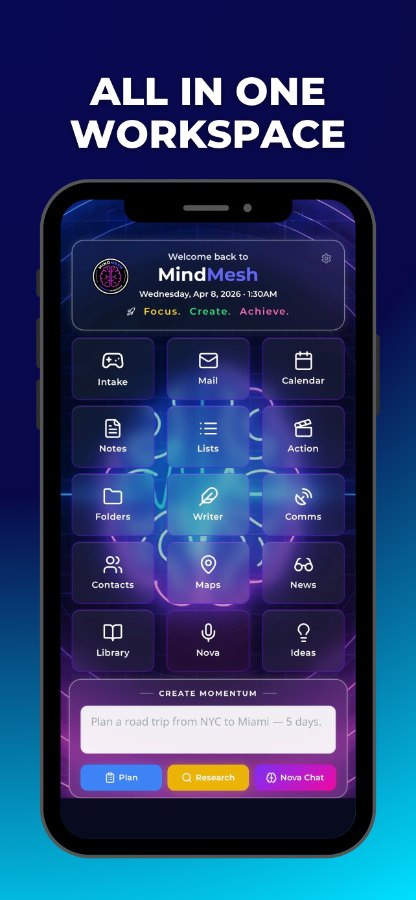
This is where platform innovations like MindMesh represent a fundamental paradigm shift for knowledge workers. Rather than acting as another isolated AI chat window that forgets everything the moment you restart your browser, MindMesh creates a persistent, connected space for your ideas, research, notes, and execution. By serving as an intelligent workspace assistant (powered by Nova), it connects past conversations with current work, ensuring that context is preserved organically over time without requiring tedious manual organization.
When your tools share a persistent memory, you eliminate the frantic tab-switching that destroys focus. You give your team a single home where knowledge evolves naturally from raw thought into completed projects.
---
The 3-Pillar Framework for Restoring Team Momentum
If your team is suffering from AI brain fry, fragmented focus, or the constant threat of workslop, adding more software is not the solution. You need a simple operational framework that prioritizes context purity and protects human cognitive bandwidth.
Here is how modern, high-velocity teams are restructuring their daily operations:
``` +-----------------------------------------------------------------------+ | THE COGNITIVE WORKSPACE STACK | +-----------------------------------------------------------------------+ | 1. Unified Context Layer (Single persistent memory for all work) | | 2. Grounded Agent Execution (AI fed by real-time organizational facts)| | 3. Protected Deep Work Hours (Uninterrupted focus > 90-minute blocks)| +-----------------------------------------------------------------------+ ```
Pillar 1: Transition from Chat Histories to Persistent Memory
Stop treating AI interaction as disposable messaging. In most organizations, employees prompt a chat model, receive a draft, copy the text into a document, and leave the conversation to disappear into an unindexed history sidebar.
Instead, insist that all AI-assisted work happens within a workspace where the background context is preserved. When an AI partner understands your past project decisions, brand tone, client preferences, and internal constraints, you stop wasting ten minutes writing complex prompts to explain who you are every time you open a tab.
Every conversation should add value to your company’s organizational memory, making the system smarter for the next task.
Pillar 2: Feed the Agent Before You Mandate Output
To eliminate workslop, establish an organizational rule: No AI agent is permitted to execute work without verified contextual grounding.
Before asking an AI agent or team member to draft a technical spec, write a client proposal, or map out a product roadmap, ensure that the underlying source material—client meeting transcripts, past architecture notes, strategic directives—is connected directly to the workspace.
When AI operates on complete, verified company context rather than broad probabilistic guessing: Draft quality improves by orders of magnitude. Verification time drops from hours to seconds. * Team trust in automated workflows is restored.
Pillar 3: Protect the 90-Minute Focus Block
Technology alone cannot fix a broken work culture. If your culture encourages real-time Slack obligations, instant email replies, and non-stop syncs, no software will save your focus.
High-velocity organizations actively protect deep focus. They replace constant status meetings with asynchronous, context-rich updates within their cognitive workspace. When team members know that all project context, decisions, and task statuses live in a transparent, connected environment, the need for "quick alignment calls" evaporates.
Replace fragmented 13-minute work bursts with structured, uninterrupted 90-minute focus blocks. Let your connected workspace handle the heavy lifting of context preservation while your human talent focuses on high-leverage strategic problem-solving.
For detailed operational guides on setting up context-aware workflows and reducing organizational debt, explore MindMesh Resources and read case studies on the MindMesh Magazine.
---
From Frantic Triage to Calm Velocity: A Day in the Life
To appreciate the impact of shifting to a unified cognitive workspace, consider what Sarah’s Tuesday looks like when context friction is removed from her organization.
It is 10:14 AM. Sarah is in her product sync. A colleague asks: "Did we promise the enterprise client that the custom permissions module would ship in Sprint 24, or was that contingent on the API refactor?"
Instead of panic-searching six isolated applications while skimming contradictory AI notes, Sarah opens her unified workspace. Because her meeting notes, client communications, Slack summaries, and Jira tasks are automatically linked in a single contextual graph, she opens a clear, single view of the project history.
Within three seconds, she reads the exact decision trail: On August 12, during the client quarterly review, the team agreed to target Sprint 24 for permissions. On August 18, the lead architect flagged an API dependency, and an explicit dependency link was recorded. The client was notified in writing on August 20 that Sprint 24 was contingent on API validation.*
Sarah gives a precise, confident answer in five seconds. No sweat, no frantic tab toggling, no guesswork.
When the meeting ends at 10:30 AM, Sarah does not face two hours of administrative cleanup, manual note formatting, or prompt engineering. Her workspace has already logged the key decisions, updated the relevant project nodes, and queued the next actions for her engineering leads with full contextual backing.
She closes her laptop screen slightly, silences non-urgent notifications, and enters a clean, unbroken 90-minute deep work session. She isn't managing tool sprawl; she is building product.
---
The Ultimate Competitive Advantage in 2026
The battle for workplace productivity has entered a new phase. In 2023 and 2024, competitive advantage belonged to the early adopters—the individuals and companies quick enough to use raw generative AI tools to draft emails or generate code snippets faster than their peers.
In 2026, raw generation is a commodity. Anyone can generate a thousand words of generic prose or fifty lines of boilerplate code in three seconds. Generating more noise faster is no longer a strategic advantage; it is an operational hazard.
Today, the ultimate competitive advantage belongs to the teams that master context clarity and cognitive ease.
The winners of the next decade will not be the companies with the longest list of software subscriptions or the most complex array of isolated AI plugins. They will be the lean, focused organizations that simplify their technical surface area, eliminate tool fragmentation, and give their people a clean, connected environment to think, create, and build.
Stop drowning in saved time. Stop letting tool sprawl shatter your day into 13-minute fragments. Eliminate the tax of context loss, restore your team's deep focus, and transform scattered conversations into an enduring engine of connected intelligence.
True operational velocity is not born from multiplying your tools, but from unifying your mind.