Stop Re-Explaining Your Life to Your Tools
Stop Re-Explaining Your Life to Your Tools Every morning, knowledge workers sit down to perform a quiet, exhausting ritual: they re-introduce themselves to their software. They copy-paste last week’s email thread,...
Every morning, knowledge workers sit down to perform a quiet, exhausting ritual: they re-introduce themselves to their software. They copy-paste last week’s email thread, summarize the client relationship, reload the project history, and remind a blank chat box what they are trying to do. The real promise of AI memory is not technical sophistication; it is relief from the daily burden of rebuilding context, so busy knowledge workers can spend less time reminding their tools who they are and more time doing the work that matters.
That burden is easy to miss because it does not look dramatic. It looks like opening six tabs before writing one paragraph. It looks like searching Slack, Gmail, Notion, Drive, and your calendar before making a simple decision. It looks like typing, “For context…” for the fifth time that day.
Modern software has become incredibly powerful, but much of it still treats every interaction like a first meeting. Your tools can generate a polished memo, analyze a spreadsheet, or draft a launch plan, yet they often have no durable understanding of the work surrounding the request. They do not know what happened yesterday. They do not know which client is sensitive about budget. They do not know that the phrase “the Q3 issue” refers to a specific unresolved conversation from last Tuesday.
So the human becomes the bridge.
And that bridge work is wearing people down.
The Hidden Work Before the Work
Consider David, a senior project manager at a boutique commercial construction firm. On a normal Thursday, he is juggling three active jobsites, coordinating with structural engineers, managing subcontractor updates, and fielding questions from clients who want clear answers without all the operational mess behind them.
A steel delivery slips by four days. The client needs an update.
In theory, this is exactly the kind of task AI should help with. “Draft a concise client update explaining the delay, the revised schedule, and the mitigation plan.”
But David cannot simply ask for that.
First, he opens his email to find the latest thread with the steel fabricator. Then he checks the project management board for the revised delivery date. Then he pulls up the original contract to confirm whether the delay affects any milestone language. Then he scans notes from the last client call because this particular client cares less about the delay itself and more about whether the opening inspection will move.
Only after collecting all of that does David paste the pieces into a prompt and explain the tone: transparent, calm, accountable, not defensive.
That is not strategy. That is digital assembly-line labor.
David is not doing the work yet. He is preparing the tool to understand the work. He is acting as a human data-router, manually carrying context from one system to another so a supposedly intelligent assistant can produce something useful.
This is the contradiction at the center of modern productivity. Our tools are smart enough to help, but not situated enough to begin.
The Clean Slate Is Not Neutral
A blank slate can feel clean. It can also be cruel.
Every blank prompt box asks the same silent question: “Who are you, what are you doing, and why should I care?” For a casual query, that is fine. For real work, it becomes a tax.
A founder preparing for an investor meeting does not need a tool that merely understands venture vocabulary. She needs one that remembers which investor asked about gross margin last time, which customer story landed well, which product metric changed this week, and which parts of the pitch are still under revision.
A lawyer working on a case does not need to re-summarize the same facts every time she drafts a motion, prepares questions, or reviews opposing counsel’s latest note. A teacher building lesson plans should not have to repeatedly explain the class level, curriculum constraints, student needs, and pacing goals before receiving useful help.
Yet this is how many professionals still work. They keep a “context doc” open like a second brain made of duct tape. They maintain folders of reusable prompts. They paste biographies, brand guidelines, client histories, project summaries, and meeting notes into tools that forget the moment the session ends.
The clean slate is not neutral. It pushes the cost of memory onto the user.
And once that cost becomes part of the workday, it quietly changes the work itself. People ask smaller questions because full context takes too long to provide. They accept generic answers because precise answers require too much setup. They stop using AI for the complicated, valuable work and reserve it for low-stakes tasks where context barely matters.
That is a design failure masquerading as user discipline.
What AI Memory Actually Promises
The phrase “AI memory” often gets discussed as if it were primarily a technical feature. Longer context windows. Better retrieval. More integrations. Smarter agents. These things matter, but they are not the human point.
The human point is relief.
AI memory matters because people are tired of reconstructing their lives for their tools. They are tired of being the only system that understands the connection between the calendar, the inbox, the task list, the meeting note, and the decision that needs to be made before 3 p.m.
A useful memory layer does not simply store more information. It preserves the relationships between information. It understands that a note from Monday, a deadline on Friday, and a half-finished draft in a workspace all belong to the same thread.
That is why the emerging category of cognitive workspaces matters. A cognitive workspace is not just another place to store notes or manage tasks. At its best, it becomes a living layer of context around your work, helping your tools understand what is active, what matters, and what has already been decided.
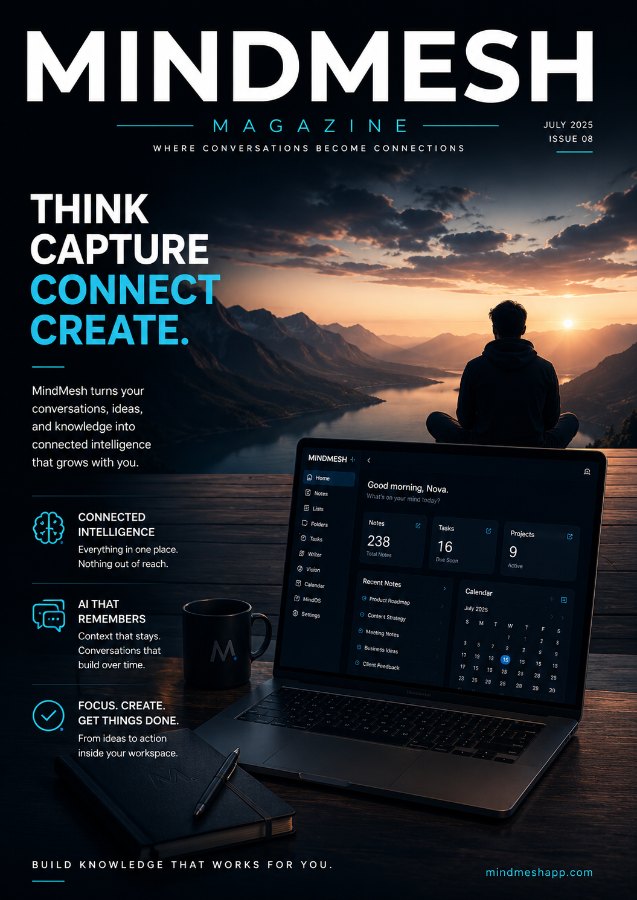
This is the problem MindMesh is built around: reducing the daily friction of scattered context so people can work from continuity instead of constantly rebuilding the scene. The point is not to make software feel magical. The point is to make it stop feeling forgetful.
When your workspace can connect your tasks, notes, meetings, and priorities, you no longer have to start every request with a long preamble. You can ask for the next useful step because the system already understands the shape of the work.
That is a very different relationship with technology.
From Prompt Engineering to Passive Context
For the last few years, prompt engineering has been treated as a new professional skill. People have been taught to write elaborate instructions: assign the tool a role, specify the audience, define the tone, include background, clarify constraints, provide examples, describe the output format, then refine through multiple rounds.
That skill can be useful. But it is also a workaround.
Prompt engineering often exists because the system does not know enough about the user, the project, or the surrounding context. We compensate by becoming extremely precise narrators of our own lives. We explain the company. We explain the customer. We explain the project. We explain what happened before. We explain what “good” means.
Then we do it again the next day.
The more powerful shift is from active prompting to passive context.
In an active prompting model, Marcus, a marketing director launching a sustainable apparel line, keeps a long document filled with brand voice guidelines, product details, audience segments, campaign dates, and approved claims. Every time he wants help drafting a launch email, social post, or creator brief, he copies sections of that document into the AI tool.
In a passive context model, Marcus does not have to rebuild the background every time. The system can see the launch plan he is working from, the campaign calendar, the approved product language, and the notes from yesterday’s review. His prompt can become simple: “Draft the announcement email for the first customer segment.”
The intelligence is not only in the model’s ability to write. It is in the workspace’s ability to know what the writing is connected to.
That difference matters. It turns AI from a talented outsider into a useful collaborator. A collaborator does not need the entire backstory before every sentence. A collaborator remembers the project.
The Real Cost Is Attention
The most expensive part of re-explaining your life is not the minutes lost to copy and paste. It is the attention lost along the way.
Every context rebuild forces a person to leave the task and go hunting. Find the note. Search the thread. Open the spreadsheet. Check the calendar. Verify the latest version. Decide what matters. Compress it into a prompt. Hope nothing important was missed.
By the time the tool is ready, the user’s focus has been broken several times.
This is why context loss feels so disproportionately frustrating. It interrupts the mental state required for good work. A founder does not merely lose five minutes gathering background for a board update. She loses the thread of the strategic question she was trying to answer. A lawyer does not merely lose time summarizing case facts. He loses the sharpness that comes from holding the argument in mind. A teacher does not merely lose time feeding standards into a planning tool. She loses the creative momentum of imagining tomorrow’s classroom.
Knowledge work depends on continuity. So does creative work. So does leadership.
When tools forget, people carry more. They carry the project state, the history, the priorities, the exceptions, the preferences, the emotional tone, and the next move. They become the memory layer for an entire stack of disconnected apps.
That is not empowering. It is exhausting.
The best productivity systems do not merely help people do more. They help people hold less in their heads.
Why More Apps Will Not Fix the Problem
The obvious response to workplace friction is often another app. A better notes app. A smarter calendar. A more flexible project board. A new AI assistant. A cleaner dashboard.
But context loss is not caused only by weak individual tools. It is caused by fragmentation between tools.
If your notes know one part of the story, your calendar knows another, your inbox knows another, and your AI assistant knows almost none of it unless you paste it in, then adding one more tool may make the problem worse. It creates another place where context can live without becoming part of the whole.
The future of work will not be won by the tool with the longest feature list. It will be won by systems that reduce the number of times a person has to stop and translate their own reality into machine-readable fragments.
This is why AI memory should be judged by practical questions:
Can it remember what I am working on without making me organize everything perfectly first?
Can it connect today’s task to yesterday’s decision?
Can it help me move between meetings, notes, and execution without losing the thread?
Can it support my judgment instead of making me perform clerical setup before every useful answer?
Can it give me back attention?
Those questions are more important than benchmark scores for most working professionals. A model that performs brilliantly in isolation but does not understand your actual workday will still feel strangely distant. A less flashy system that preserves context across your real tasks may feel dramatically more useful.
People do not need software that wins demos. They need software that survives Tuesday.
A Better Tool Should Remember the Shape of Your Day
The ideal is not a world where technology knows everything about us. Memory must be controlled, transparent, and trustworthy. People should understand what a system remembers, why it remembers it, and how to correct or remove it.
But within those boundaries, the direction is clear. Tools should remember the shape of the work they are supporting.
They should know that the document open on your screen relates to the meeting in thirty minutes. They should recognize that the task you keep postponing is tied to the proposal due Friday. They should help you pick up where you left off after a call, a school pickup, a client emergency, or an afternoon spent putting out fires.
For busy professionals, this is not a luxury. It is the difference between a day that compounds and a day that resets.
A day that compounds has continuity. The morning’s notes inform the afternoon’s draft. The meeting decision updates the task list. The client concern remains visible when the follow-up email is written. The system helps preserve momentum.
A day that resets is full of tiny restarts. Every app opens cold. Every assistant needs a briefing. Every task requires archaeological work before progress can begin.
Too much of modern work still runs on resets.
The Future Belongs to Continuity
AI memory will be marketed with technical language because technical language is easy to sell. But the deeper value is human. It is the relief of not having to hold every thread alone. It is the calm of opening a workspace that remembers what matters. It is the freedom to spend your best energy on judgment, creativity, relationships, and execution instead of digital stage-setting.
This is where the conversation about productivity needs to mature. The question is not whether AI can generate more words, more plans, more summaries, or more suggestions. It can. The question is whether it can reduce the burden of managing the context around those outputs.
For more thinking on cognitive workspaces, workflows, and the future of organized work, MindMesh Magazine explores how professionals are rethinking the systems behind their days.
The next generation of tools should not make people better at explaining themselves to software. It should make that explanation less necessary.
You should not have to introduce yourself to your own mind every morning.