A founder I know had 143 ChatGPT conversations, 38 Claude threads, a handful of Gemini exports, and a Perplexity tab graveyard open across two browsers. Buried in there were a pricing framework, a hiring scorecard, a sharp customer segmentation idea, and the best draft of an investor update he’d written all quarter. He had already done the thinking. The problem was that he couldn’t use it twice.
That’s the shift worth paying attention to. Saved chats are turning into a new unit of knowledge work. Not because chat history suddenly became elegant, and not because every model now has perfect memory, but because people are starting to treat AI conversations as something more valuable than disposable outputs. A good thread is no longer just “what the model said.” It’s research, strategy, language, decisions, and direction. It’s work material.
The catch is that most saved AI chats still die the same quiet death as old notes: preserved, but unusable. The real advantage shows up when a conversation stops being a transcript and starts becoming an asset.
The hidden stockpile sitting inside everyone’s AI tools
Heavy AI users already know this feeling. You remember having a great exchange three weeks ago. Maybe it was the conversation where Claude helped you compare two market entries. Maybe ChatGPT gave you a clean operating framework for a team retreat. Maybe Perplexity surfaced three useful sources you actually trusted. You don’t want to redo the work, but you also don’t know where that conversation lives now, what you called it, or whether the good part is on message 6 or message 19.
So people improvise.
Some rename chats and star the ones that feel important. Others copy chunks into Notion, paste excerpts into docs, or keep a running “AI” folder in Apple Notes, Google Docs, Readwise, Obsidian, or Slack. When that still feels fragile, they screenshot answers, bookmark Claude threads, or export ChatGPT conversations just to make sure the work survives somewhere.
That behavior matters because it signals a change in how users value the interaction. They no longer see AI chats as temporary sessions. They see them as recoverable value.
For the first wave of mass AI use, the main skill was prompting: how to ask better, how to iterate, how to steer the model toward a useful answer. That still matters. But now a second problem has arrived. Once you get a useful answer, where does it go? How do you find it later? How does it connect to the project it was meant to help?
That’s why the market is moving beyond the chat window.
The obvious framing is memory. The better framing is reuse.
A lot of the conversation around AI right now gets squeezed into one word: memory.
There’s a reason for that. OpenAI has made memory a visible product theme inside ChatGPT, including broader memory rollouts announced in 2024 and continued updates that let the system reference past chats and saved preferences. Google has been building persistent context into Gemini experiences. Claude has leaned into larger context windows and project-style workflows that make longer-running work sessions more practical. Around the big model apps, a smaller ecosystem of tools has sprung up to capture prompts, clips, transcripts, and cross-model context.
Those are real product signals. But they don’t quite name the deeper shift.
The bigger story is not just that users want AI to remember them. It’s that users want their own machine-assisted thinking to survive the session. Those are related problems, but they are not the same problem.
If ChatGPT remembers that you run a SaaS company, that’s helpful. If your best strategy conversation from last month turns into a reusable operating brief for the team, that’s much more valuable.
One is personalization. The other is something sturdier: a way to carry useful thinking forward into the rest of the work.
And that changes behavior. Once people realize that a great AI conversation can become durable work material, they start saving chats differently. Not as souvenirs, but as building blocks.
That is where “saved chats” starts to look less like admin and more like a productivity primitive.
Why people are suddenly saving AI chats like they matter
Because they do.
A strong AI conversation often contains compressed work that would have taken much longer to produce manually. It can hold the first draft of a decision, the shape of a plan, the wording of a hard email, the structure of a launch, the pros and cons of a hire, or the logic behind a new offer. Even when the output is imperfect, the exchange itself carries context: what you were trying to solve, what constraints mattered, what tradeoffs came up, what language clicked.
That context is usually more valuable than the final paragraph.
Take a simple founder workflow. You open ChatGPT to think through whether to raise prices. The conversation includes customer segmentation, risk analysis, messaging options, possible objections, and a rollout sequence. If you leave that in chat history, it’s trapped inside a transcript. If you turn it into a pricing decision note linked to your roadmap, your customer calls, and your draft announcement, it becomes part of the company’s operating memory.
Same thinking. Different outcome.
Creators feel this too. A brainstorming session with Claude might generate ten angles for a podcast series. The real value is not the one draft you copied into a Google Doc. It’s the pattern of ideas: which themes had energy, which examples felt original, which audience objections kept appearing. That conversation can become an editorial system if you preserve it properly.
Operators do it with meeting prep. Researchers do it with source synthesis. Consultants do it with account context. Recruiters do it with candidate summaries. Product people do it with user-feedback analysis.
The saved conversation is becoming the first usable artifact.
Why native chat history is not enough
The problem with model-native chat history is not that it exists. It’s that it behaves more like storage than work.
Most chat interfaces are built around sessions. That makes sense for generating answers, but not for building continuity across projects. Even when search improves, the unit is still the conversation thread. You have to remember where the thinking happened, then reopen the full exchange, then hunt for the useful part, then manually carry it into the next piece of work.
That is friction disguised as memory.
Chat history also tends to flatten everything into the same shape. A brilliant market analysis thread and a throwaway request to rewrite a headline live side by side as “saved chats.” One matters. One doesn’t. Most systems do very little to help you distinguish between transcript, reference, decision, workflow, and asset.
This is where people start to feel the cognitive tax.
You save everything because you might need it. Then you trust none of it because there’s too much. The result is familiar: a graveyard of transcripts, loosely labeled, occasionally searched, rarely reused. It looks organized from a distance. Up close, it’s just another pile.
That’s why “save ChatGPT conversations” is only the beginning of the workflow, not the end of it.
Where MindMesh fits
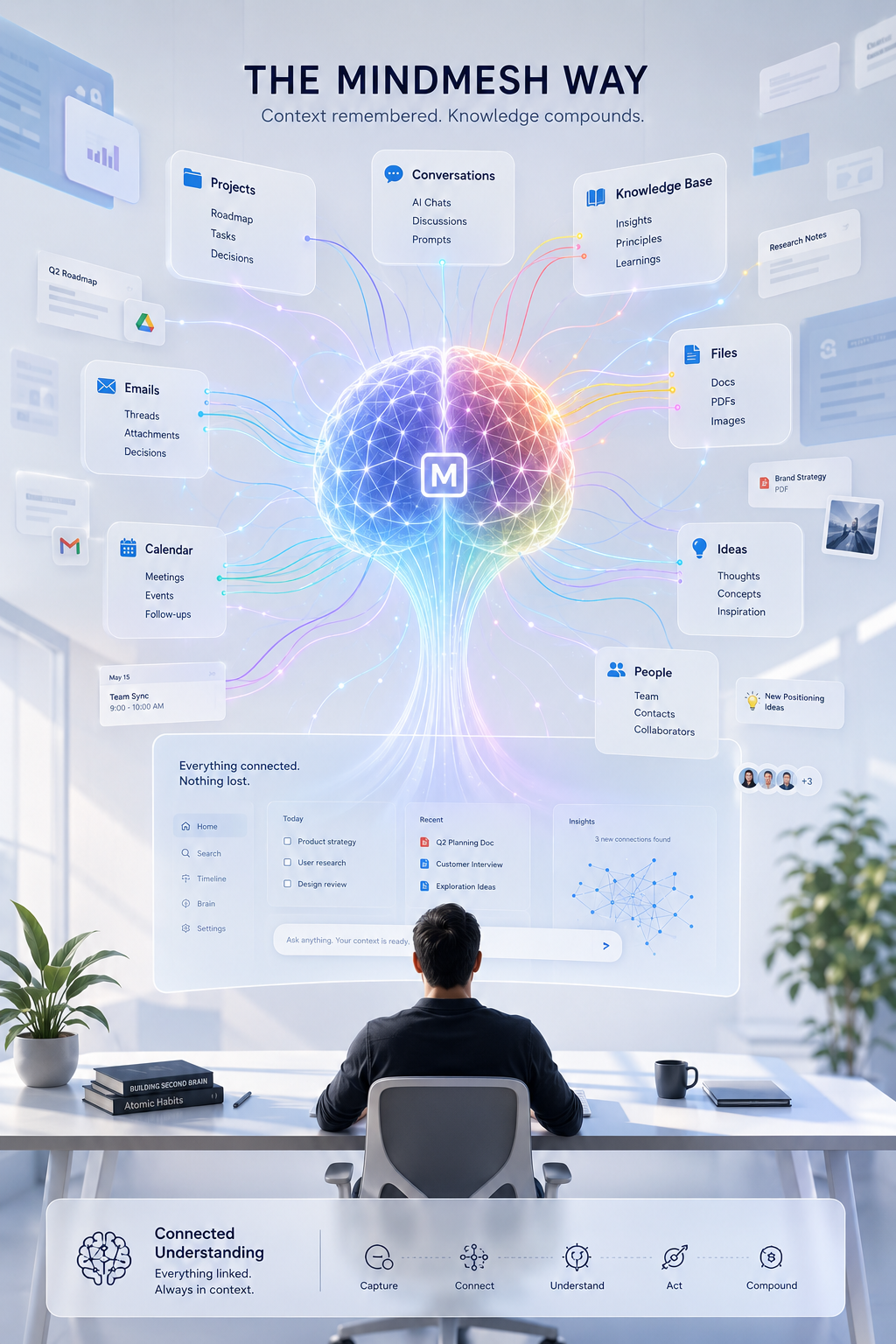
This is the gap [MindMesh](https://mindmeshapp.com) is built for. Not as another place to hoard chat logs, but as a cognitive workspace where saved conversations can connect to the rest of your life and work.
If your thoughts deserve a better home, your best AI conversations do too.
Inside MindMesh, a useful exchange doesn’t have to stay trapped as an isolated session. It can live alongside your notes, tasks, documents, lists, and project materials in one connected environment. That matters because the value of a saved chat usually depends on what it relates to. A strategy conversation by itself is helpful. A strategy conversation linked to your roadmap, meeting notes, customer feedback, and next actions is operational.
That is the difference between archive and working memory.
MindMesh is especially useful when your work already spills across models. A founder might use Perplexity for live research, Claude for synthesis, and ChatGPT for drafting. The problem is not getting one good answer from each. The problem is turning those answers into one coherent project record. A connected workspace makes that possible.
The real shift: from transcript to asset
A saved chat becomes useful when it changes format.
Not literally every time, but conceptually. The raw conversation is often too messy to function as durable knowledge. Good AI sessions are full of detours, retries, false starts, and temporary wording. That’s normal. Thinking is lumpy. But reusable work needs a cleaner shape.
Here’s the practical mental model:
- Transcript: the full conversation as it happened
- Extraction: the parts worth keeping
- Structure: a format that matches the work
- Connection: links to the project, decision, people, or task it supports
- Reuse: the ability to apply it again without starting over
That’s the progression.
A research chat becomes a decision memo. A strategy thread becomes a project brief. A long ideation session becomes a content bank. A customer-analysis exchange becomes account context for the next call. A meeting prep conversation becomes an ongoing operating note.
This is what it means for saved chats to become a productivity primitive. The primitive is not the transcript itself. The primitive is the ability to capture machine-assisted thinking and turn it into reusable project context.
That sounds abstract until you’ve felt the alternative. Starting over is expensive, not just in time but in mental load. Reopening the same problem and restitching the same background wears people down. It makes AI feel helpful in the moment but strangely bad at supporting an actual body of work.
The next gain is not more answers. It’s continuity.
What this looks like in real work
Let’s make this concrete.
A founder building a launch plan
You use Gemini to pressure-test a launch angle, Claude to sharpen positioning, and ChatGPT to draft the rollout sequence. Normally, that thinking gets split across three tools and disappears into three histories.
A better workflow looks like this: save the strongest sections from each conversation, turn them into a launch brief, and connect that brief to your messaging notes, timeline, content tasks, and team handoff. In MindMesh, that can live as one project with the transcript excerpts, final decisions, and next actions all attached.
Now the chats are not separate events. They are source material for one launch.
A creator building a repeatable content system
You ask Perplexity for source material, use Claude for outline exploration, and use ChatGPT to test hooks. Instead of keeping 12 separate chats called “newsletter ideas” or “video angles,” you extract the durable pieces: recurring themes, good phrasing, audience objections, examples worth reusing.
Those become a living content library, not a pile of transcripts. The next time you create, you’re starting from accumulated signal, not an empty prompt box.
That is a better use of saved AI chats than simply exporting them for safekeeping.
An operator managing account context
You have a customer call next Thursday. Two weeks ago, you had an AI conversation about renewal risk, adoption blockers, and stakeholder mapping for that account. If that thread stays buried in chat history, it won’t help much. If it becomes an account note connected to meeting prep, past calls, follow-ups, and tasks, it becomes part of the client relationship.
Now the AI conversation is not just remembered. It’s situated.
A team member doing research across models
You use Perplexity for sources, Claude for synthesis, and ChatGPT for scenario analysis. The raw transcripts are useful, but only once. The reusable asset is a research note with linked sources, conclusions, open questions, and next actions.
That note can survive beyond the model, beyond the browser tab, and beyond your memory of how you got there.
That’s the real prize.
Why this matters even more in a multi-model world
This trend gets stronger as people spread work across tools.
You can see it in the products themselves. Perplexity is built for live web research and citation-heavy discovery. Claude has become a favorite for long documents, reasoning, and writing tone. ChatGPT remains the default workhorse for many people because it sits in the middle of drafting, analysis, and general problem-solving. Gemini fits naturally into Google-heavy workflows, especially where Docs, Gmail, and Drive already shape the day.
Serious users notice those differences quickly. They stop treating model choice like a loyalty test and start treating it like task selection.
That creates a more practical problem: not “which model is best?” but “how do I preserve useful thinking across all the places it happens?”
Model-native memory can help inside each ecosystem, but it does not automatically solve the cross-model layer where real work accumulates. If your best thinking is distributed across tools, continuity has to exist above the tools. Otherwise every conversation stays locked to the app that generated it.
This is why AI memory is turning into a real category rather than a side feature. It also explains why more people are looking for systems that can organize AI conversations by project, not just by date or app. The need is no longer basic retention. It’s coordinated reuse.
For readers who want to explore that larger shift, MindMesh Magazine has already tracked adjacent questions around [AI that remembers conversations](https://resources.mindmeshapp.com/blog/ai-that-remembers-conversations) and [the missing layer between AI and work](https://resources.mindmeshapp.com/blog/the-missing-layer-between-ai-and-work). This piece sits one step forward from both: once a conversation is worth saving, how does it become useful work?
The risk is building a prettier graveyard
There’s a small trap here, and the market is going to fall into it repeatedly.
As saved-chat behavior grows, more tools will promise better capture, cleaner archives, smarter retrieval, and auto-tagging. Some of that will be genuinely useful. Some of it will amount to building a more elegant basement full of boxes.
That’s still a graveyard.
The standard should be higher. A saved conversation should help you make the next move faster. It should reduce rework. It should carry decisions forward. It should be easier to apply than to rediscover. If a tool saves your chat beautifully but leaves the thinking disconnected from everything else you do, then it solved storage, not productivity.
That distinction is going to matter more than people think.
Because the future of working with machines is not just about generating outputs on demand. It’s about building a body of usable, machine-assisted thought that compounds over time. That body of thought needs a home, not just a history panel.
What to do with your saved chats now
If you already have a pile of AI conversations, don’t start by trying to organize all of them. That becomes a weekend project nobody finishes.
Start smaller.
Pick five conversations you know were genuinely useful. Then ask:
- What project did this actually support?
- What is the durable insight here?
- Should this become a note, brief, checklist, decision, or reference?
- What does it need to connect to so I’ll use it again?
That simple move changes everything. You stop treating the transcript as the final artifact and start treating it as raw material.
From there, you can build a cleaner habit: save selectively, extract the valuable parts, structure them for the work they serve, and keep them in a connected workspace where they can resurface when needed. If you want a practical place to do that, explore [MindMesh Magazine](https://resources.mindmeshapp
Your thoughts deserve a better home.
Turn scattered context into a workspace that helps you think, organize, and move.
Explore AI Models