The Hidden Tax of the Multi-Tab Mind: How Context Switching Is Quietly Draining Founder Focus
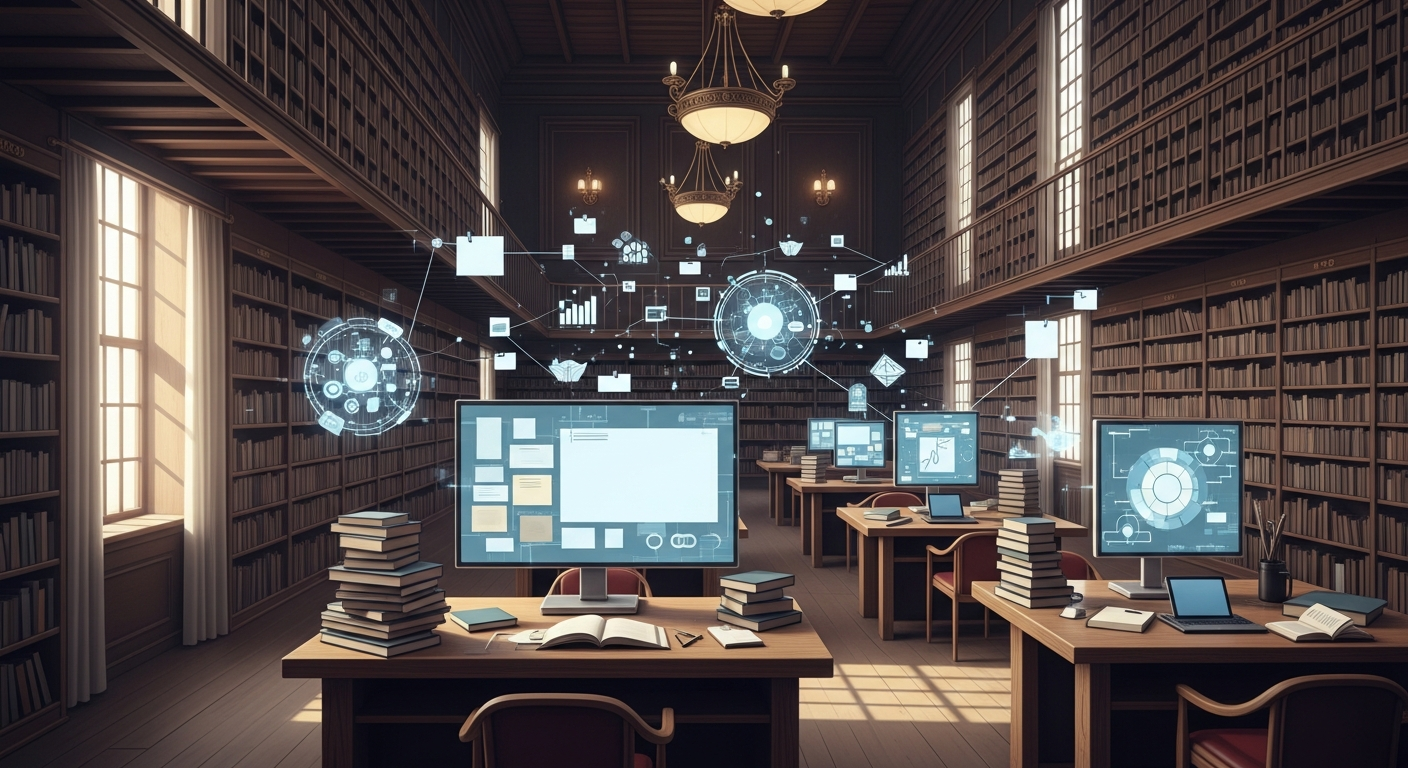
A founder's workday can disappear into tabs, notifications, and disconnected AI chats. The real productivity bottleneck is the cognitive friction of rebuilding context.
The Hidden Tax of the Multi-Tab Mind: How Context Switching is Quietly Draining Founder Focus
It is 9:14 AM on a Tuesday, and your browser is already sweating.
You have forty-two tabs open. On the far left, a half-drafted investor update sits cold in a Google Doc. In the middle, three separate chat windows—one for Claude, one for ChatGPT, and one for Gemini—hold fragments of a competitive analysis you were running before a Slack notification pulled you away. On the far right, your email inbox looms, a digital waiting room of unresolved decisions.
You feel a subtle, persistent pressure behind your eyes. It isn’t physical exhaustion; you slept seven hours. It is cognitive fatigue. You have spent the first hour of your workday not creating value, but performing mental gymnastics—jumping across digital chasms, re-reading paragraphs to remember where you left off, and manually copy-pasting text between disconnected tools.
This is the reality of the modern knowledge worker, particularly the founder or operator. We have more computational power at our fingertips than any generation in history, yet our daily experience of work feels increasingly fragmented, frantic, and shallow.
The bottleneck of modern productivity is no longer information access or processing speed. It is the cognitive friction of context switching. To survive the deluge of tools, notifications, and AI interfaces, we must transition away from scattered, browser-based workflows and build a unified cognitive workspace that preserves our mental momentum.
---
The Anatomy of Context Loss: Why Your Brain Feels Tired Before Noon
To understand why our current digital environments are failing us, we have to look at how the human brain processes work.
Psychologists and cognitive scientists frequently point to "working memory"—the mental workbench where we hold and manipulate information in real-time. Unlike a computer’s hard drive, human working memory is incredibly limited. It can typically hold only four to seven chunks of information at once.
When you are deeply immersed in a task—say, writing a product specification document—your working memory is fully loaded. You hold the customer’s pain points, the technical constraints, the launch timeline, and the specific tone of voice in your mind simultaneously. This state of deep cognitive alignment is what psychologists call "flow."
But what happens when a Slack notification flashes in the corner of your screen?
``` [Slack] Sarah: "Hey, do you have the link to the Q3 design assets?" ```
Even if you only look at the message for three seconds, the damage is done. Your brain is forced to perform a "context switch." It flushes the product specification context out of your working memory and loads the Q3 design asset context.
According to research from the American Psychological Association, even brief mental blocks created by shifting between tasks can cost up to 40% of someone's productive time. More critically, researchers at the University of California, Irvine, found that it takes an average of 23 minutes and 15 seconds to return to a deep task after a single interruption.
When you multiply this across a ten-hour workday filled with browser tabs, email alerts, and multiple AI chat windows, you realize that most knowledge workers are operating in a state of permanent cognitive deficit. We are paying a continuous "context tax," leaving a trail of mental residue across every tool we touch.
---
The AI Fragmentation Paradox
When the current wave of generative AI arrived, the promise was simple: these tools would automate the mundane, streamline our workflows, and give us our time back.
Instead, we got the AI Fragmentation Paradox.
Rather than simplifying our work, AI has added another layer of complexity to our digital environments. Because AI capabilities are scattered across different models and platforms, founders now find themselves managing an entirely new set of silos.
A typical research workflow in 2026 looks like this: 1. You ask Claude to analyze a raw dataset because of its superior reasoning capabilities. 2. You copy that analysis and paste it into ChatGPT to generate a customer-facing summary, utilizing a custom GPT you built. 3. You copy that summary and paste it into Notion to format it. 4. You copy the formatted text and paste it into an email draft or a Slack message to share with your team.
In this workflow, you are the integration layer. You are the human bridge connecting these disparate systems. The time you saved by using AI to write the summary is entirely consumed by the mechanical overhead of moving data between tabs and re-establishing context at every step.
This is not a technology problem; it is a spatial problem. Our digital workspaces were designed in the 1990s around the metaphor of files, folders, and isolated applications. They were never built to handle the fluid, multi-directional flow of information that defines modern collaborative work with machines.
---
Reclaiming the Mental Canvas: The Rise of the Cognitive Workspace
If the browser tab is the enemy of focus, what is the alternative?
The solution lies in shifting our paradigm from a "document-first" or "app-first" workflow to a cognitive workspace.
A cognitive workspace is a digital environment designed to mirror the associative, non-linear way the human brain actually works. Instead of forcing you to jump between a note-taking app, a task manager, and an AI assistant, a cognitive workspace unifies these elements into a single, continuous context layer.
This is where MindMesh enters the picture. Designed specifically for founders, operators, and knowledge workers who manage high-cognitive-load projects, MindMesh acts as an external cognitive layer. It integrates your tasks, notes, calendar, and AI interactions into a single, fluid workspace.
Instead of treating your AI assistant as a separate tab you have to visit, MindMesh integrates context directly where you work. When you open a project canvas, the system already understands the relevant emails, calendar events, and previous notes associated with that project. You don't have to spend ten minutes gathering your materials before you start writing; the context is preserved, waiting for you.
By reducing the physical and mental distance between information gathering, synthesis, and execution, a cognitive workspace eliminates the micro-decisions that trigger context switching. You no longer have to decide which tab to open next; the workspace adapts to your current focus.
---
The Three Pillars of a High-Performance Founder Workflow
Transitioning to a cognitive workspace requires more than just new software; it requires a structural shift in how you design your daily workflows. High-performance operators build their systems around three core pillars:
1. Context Preservation over Information Storage
Traditional productivity systems focus heavily on storage—where to file a document, how to tag a note, or what folder to put an asset in. This is a mistake. Storage-first systems require high maintenance and offer low utility when you are in the middle of deep work.
Instead, focus on preservation. When you pause a project at the end of the day, do not just close the tabs. Create a "context anchor." Write down: What you were doing when you stopped. The exact next step you need to take. * The three most important links or documents you will need to open tomorrow morning.
By anchoring your context, you prevent the "cold start" problem the following morning, allowing you to slide back into deep work in minutes rather than hours.
2. Asynchronous AI Integration
Stop treating AI as a conversational partner that requires your undivided attention. When you chat with an AI in a dedicated tab, you are forced to wait for the output, read it, respond, and iterate in real-time. This is synchronous work, and it is highly distracting.
Instead, move toward asynchronous AI workflows. Use tools that allow you to drop a prompt or a dataset into a workspace, assign it as a background task, and continue working on something else. Let the machine do the heavy lifting in the background, presenting its findings within your active workspace when you are ready to review them.
3. The Single Source of Focus
The human brain cannot multi-task. Therefore, your digital environment should not attempt to display multiple competing priorities simultaneously.
Your active workspace should only show the information required for the task at hand. If you are writing a board deck, your task list, calendar, and unread Slack messages should be completely invisible. A clean workspace is not just an aesthetic preference; it is a cognitive necessity.
---
A Practical Guide to Auditing Your Cognitive Load
If you want to reclaim ten hours of lost focus this week, you can begin with a simple, three-step audit of your current digital setup.
| Step | Action | Objective | | :--- | :--- | :--- | | 1. The Tab Audit | At the end of today, count your open tabs. Group them into "Active" (working on right now), "Passive" (reading later), and "Zombie" (open for more than 48 hours). | Identify where your mental residue is being trapped and close the zombies immediately. | | 2. The Tool Consolidation | List every tool you used today to complete a single task. If you had to use more than three tools to write one email or report, map the friction points. | Find the manual copy-paste loops that are draining your cognitive energy. | | 3. Establish a "Shutdown Ritual" | Spend the last 10 minutes of your workday clearing your digital desk. Close all tabs, write your context anchors for tomorrow, and shut down your computer. | Create a clean cognitive break between work and life, preventing mental leakage into your evening. |
---
The Future of Working with Machines
As we look toward the future of knowledge work, the division of labor between humans and computers is shifting. Machines are becoming incredibly proficient at synthesis, analysis, and generation.
Our value as human operators no longer lies in our ability to retrieve data or execute repetitive digital tasks. Our value lies in our judgment, our creativity, and our ability to connect disparate ideas—capacities that require deep, sustained focus.
If we continue to work in fragmented, noisy, multi-tab environments, we are actively handicapping our greatest competitive advantage. We are turning ourselves into slow, easily distracted routers of information, rather than deep thinkers.
The founders and operators who thrive in the coming decade will not be those who work the longest hours or adopt the most tools. They will be the ones who master their attention, protect their cognitive energy, and build workspaces designed for deep, uninterrupted flow.
The choice is simple: you can continue to pay the daily tax of the fragmented mind, or you can build a workspace that protects your most valuable asset—your focus.
Your focus is your leverage; do not let it slip away in an ocean of open tabs.