Present But Scattered: Why Tool Fatigue Is Quietly Ruining How We Talk to Our Teams
Present But Scattered: Why Tool Fatigue Is Quietly Ruining How We Talk to Our Teams The blue light of the monitor reflects in your eyes as your product designer, Clara, walks you through her latest wireframes over Zoom....
The blue light of the monitor reflects in your eyes as your product designer, Clara, walks you through her latest wireframes over Zoom. You nod, murmuring "makes sense" and "looks clean," but your eyes are subtly tracking a red notification dot on your Slack icon. Underneath the active window, a browser with twenty-four open tabs is quietly consuming your machine’s memory—and your own. You are physically there, but mentally you are still trapped in the residue of an angry email from an investor, a half-written Jira ticket, and a lost document link. True leadership and effective team communication in the agent era require cognitive presence, which is impossible to maintain when our mental context is constantly fragmented across a dozen disconnected digital tools.
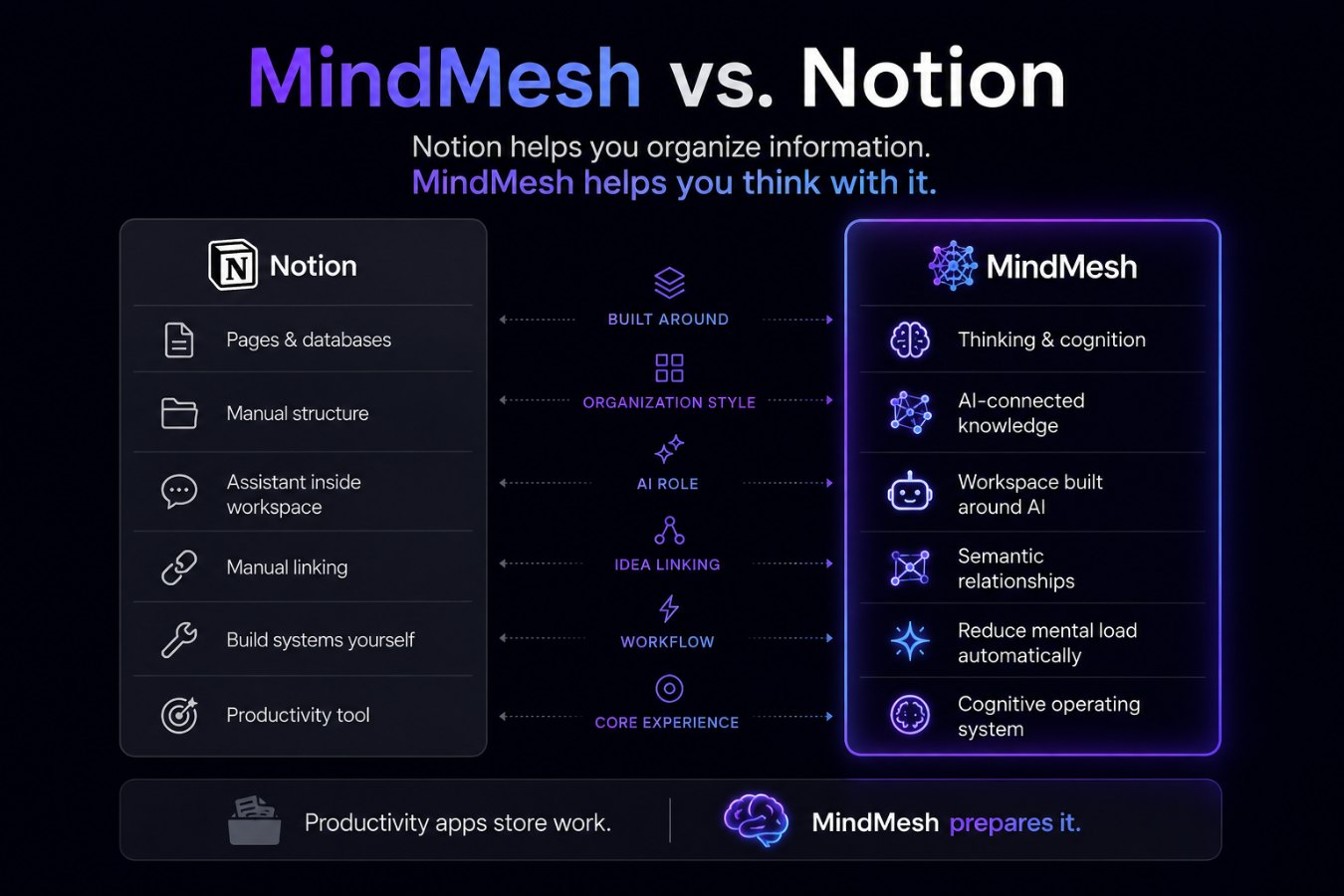
This is the reality of the ten-tab morning, a quiet tax levied on every interaction we have with our teams. We have more ways to send messages than at any point in human history, yet we have never felt more disconnected from the people we lead. The tools that promised to bring us closer have instead built a wall of digital clutter between us, leaving us present in name only, while our minds remain scattered across a vast, unmapped wilderness of software. To combat this, forward-thinking teams are shifting toward a unified cognitive workspace that acts as an external memory system. When an idea is worth keeping, MindMesh gives you a place to capture it, organize it, and turn it into action without losing your mental thread.
---
The Illusion of the "Director" Era
We were promised a different version of the future. As we entered the mid-2020s landscape, the narrative surrounding the future of work underwent a dramatic shift. Industry reports introduced what they called "the new agency equation"—the transition of the modern knowledge worker from a hands-on "doer" to an executive "director." The promise was simple: autonomous agents and intelligent systems would handle the tedious execution of tasks, freeing founders, managers, and operators to focus on high-level strategic direction and human relationship management.
But the reality on the ground looks vastly different. Instead of stepping into the role of strategic directors, leaders have been drafted as digital babysitters. Recent workplace studies reveal that over half of managers are facing unprecedented cognitive load, driven not by a lack of capability, but by the sheer volume of single-purpose tools they must coordinate.
Consider the typical workflow of Sarah, a startup founder trying to coordinate a product launch. She is managing two human engineers, an AI copywriter, and an automated QA agent. To review a simple launch plan, she must check a project board in one app, read a strategy document in another, review a video walkthrough on a third platform, and track the team's real-time discussion across three different Slack channels. Instead of delegating tasks to intelligent assistants, Sarah spends her days chasing digital breadcrumbs, manually bridging the gaps between systems that refuse to talk to one another.
This constant context loss creates a phenomenon psychologists call "attention residue." When you switch from writing a technical specification to answering a team member's question, a portion of your active memory remains stuck on the previous task. Multiply this by thirty switches an hour, and by the afternoon, your brain is operating at a fraction of its capacity. We are not directing; we are merely reacting, exhausted by the friction of our own systems.
---
The Cognitive Tax of the Ten-Tab Morning
The modern workspace has become a battleground for our attention. Every tool we add to our stack claims to solve a specific problem, but collectively, they create a systemic crisis. The human brain was never designed to hold the state of twelve different software applications simultaneously. When we force it to do so, we experience a silent, compounding exhaustion that degrades our decision-making and erodes our empathy.
Without structural relief, the mental load of tracking where information lives—whether a feedback item was left in a Figma comment, a Notion page, an email thread, or a Slack DM—consumes the very cognitive bandwidth required to solve the problem itself.
Consider the physical equivalent: imagine working at a desk where every document is locked in a different drawer, each requiring a different key, and the drawers constantly rearrange themselves throughout the day. You would spend eighty percent of your energy simply accessing your tools, leaving only twenty percent for actual work. Yet, this is exactly what we tolerate in our digital environments. We have traded deep, focused thought for a state of perpetual hyper-reactivity, mistaking the speed of our tool-switching for actual progress.
When our mental workspace is fragmented, our communication becomes transactional. We stop asking "Why are we building this?" and start asking "Where is the link to this?" The strategic vision of the company is swallowed by the immediate logistics of finding information.
---
Why More Communication Channels Won't Save Us
When a team’s alignment begins to slip, the classic management response is to add more communication. We create a dedicated "announcements" channel, institute daily standups, mandate weekly status write-ups, or demand that everyone use a new video-messaging tool to "keep in touch."
This response misdiagnoses the disease. The breakdown in team communication is rarely caused by a lack of channels; it is caused by the absence of a unified cognitive foundation. When a leader's mental context is shattered by tool fatigue, their communication style shifts from proactive and empathetic to reactive, shallow, and anxious.
Take the example of David, an engineering partner at a growing software firm. During a weekly sync, his lead developer raises a subtle concern about technical debt that could delay their release by a month. In a world of low cognitive load, David would pick up on the developer's hesitant tone, ask clarifying questions, and collaboratively realign their timeline. But today, David’s mind is racing. He is trying to remember where he saved the client feedback from yesterday—was it in a Google Doc, a Jira ticket, or a scribble on his physical desk?
Because his mental capacity is entirely consumed by this search, David misses the developer's cue. He offers a generic, rushed "Let's push through it" and moves to the next agenda item. The developer leaves the meeting feeling unheard, the technical debt remains unaddressed, and the project eventually slips.
When digital clutter dominates our internal landscape, we lose our capacity for active listening. We communicate in fragments because we think in fragments. We send quick, poorly contextualized messages that create confusion, which in turn generates more messages, compounding the very noise we are trying to escape.
---
Reclaiming Presence Through a Unified Cognitive Workspace
To break this cycle, leaders must realize that their brain is a processing unit, not a storage device. We cannot maintain leadership presence if we expect our working memory to hold the state of a dozen different software tools simultaneously. The solution is not to download another productivity app, but to establish a cognitive relief valve—a single, unified environment that holds our context for us so our minds don't have to.
This is the philosophy behind the emergence of dedicated cognitive environments. Rather than forcing you to jump between isolated silos of information, a platform like MindMesh acts as an external memory system, capturing, organizing, and synthesizing your tasks, notes, and communications into a single flow. When your digital environment is unified, the mental friction of context switching disappears. You no longer have to remember where an idea was born or where a task is documented; the workspace preserves the context, allowing you to move from deep focus to collaborative action seamlessly.
Designing these workflows requires a shift in how we view our digital infrastructure. It is not just about utility; it is about protecting our mental bandwidth. By offloading the administrative burden of context tracking to a unified system, you free up the cognitive capital required to perform your actual job: leading people.
---
The Relational ROI of Mental Clarity
When a leader reclaims their cognitive presence, the effects ripple across the entire organization. The ROI of mental clarity is not measured in keystrokes or closed tickets; it is measured in the quality of human relationships and the speed of organizational decision-making.
A present leader can show up to a 1-on-1 meeting and actually listen. They can hear the unspoken hesitation in a direct report's voice, identify the systemic bottlenecks that are burning out their team, and offer clear, decisive guidance. They do not need to constantly ask "Where are we on this?" because their cognitive workspace has already provided them with the context before the meeting even started.
Consider the contrast between two leadership styles in the modern workplace:
The Fragmented Leader
Constantly distracted during meetings, looking at secondary screens. Frequently asks for context to be repeated because they cannot locate the relevant files. Responds to urgent messages with vague, anxious, or rushed directives. Rely on constant status updates and micromanagement to feel in control.
The Present Leader
Arrives at discussions fully briefed, with all context unified beforehand. Listens deeply, picking up on subtle team dynamics and unvoiced risks. Asks high-leverage questions that challenge assumptions and spark innovation. Provides clear, actionable feedback that unblocks their team for days at a time.
The latter is only possible when your digital tools serve your mind, rather than the other way around. In an era where AI agents can draft code, write copy, and analyze data at scale, the ultimate competitive advantage for any leader is not their technical output. It is their ability to bring absolute, undivided cognitive presence to their strategy and their people.
---
The Quiet Power of Being There
We have spent the last decade optimizing our businesses for speed, adding tool after tool in the hope of squeezing out marginal gains in efficiency. In doing so, we have quietly sacrificed the very thing that makes organizations function: clear, empathetic human communication.
The path forward does not require us to abandon modern technology, but it does require us to establish boundaries. We must refuse to let our attention be carved up into a thousand tiny pieces by a disconnected tech stack. By consolidating our digital lives into a unified cognitive workspace, we do more than just clean up our desktops; we restore our capacity to connect, to listen, and to lead.
"True leadership cannot be automated, delegated, or simulated by an agent, because at its core, leadership is the art of being entirely present for the people who trust you to show them the way."