Exhausted by Efficiency: How to Reclaim Your Creative Momentum in the Age of AI Overload
--- title: "Exhausted by Efficiency: How to Reclaim Your Creative Momentum in the Age of AI Overload" thesis: "True professional momentum isn't achieved by adding more high-speed AI tools to a fragmented stack; it is...
--- title: "Exhausted by Efficiency: How to Reclaim Your Creative Momentum in the Age of AI Overload" thesis: "True professional momentum isn't achieved by adding more high-speed AI tools to a fragmented stack; it is built by centralizing cognitive context in a single workspace so the human mind can focus on deep, uninterrupted execution." category: "Momentum" image_path: "/images/library/mindmesh-calm-workspace-focus.jpg" image_alt: "A clean, minimalist wooden desk featuring a single open laptop displaying a unified, organized workspace, alongside a ceramic coffee mug and a small potted plant in soft, natural morning light." ---
David sits at his desk at 9:00 PM, his face illuminated by the cold blue glow of three monitors. On one screen, a generative AI tool drafts a marketing proposal; on another, an automated assistant summarizes a client meeting; on the third, a project management board flashes with fresh notifications. On paper, David is a hyper-efficient founder. He is producing more content, shipping more code, and answering more emails than ever before in his career. Yet, staring at dozens of open browser tabs, he feels an acute, heavy exhaustion. His strategic progress has stalled because he spends his days managing tools rather than doing meaningful work. True professional momentum isn't achieved by adding more high-speed AI tools to a fragmented stack; it is built by centralizing cognitive context in a single workspace so the human mind can focus on deep, uninterrupted execution.
This is the central paradox of the modern knowledge worker. We have never had more powerful tools at our disposal, yet we have never felt more fractured. While AI adoption rates among enterprises and creators have surged over the past two years, actual focus efficiency has plummeted. We are moving faster, but we are traveling shorter distances. The tools that promised to liberate our minds have instead constructed a high-speed hamster wheel.
To break free, we must understand how to manage our mental energy and transition toward a unified digital environment that protects our attention rather than scattering it across the digital ether. When our tools are scattered, our thoughts follow suit, leaving us with a superficial sense of productivity that masks a deeper, systemic stagnation. By integrating our workflows into a streamlined platform like MindMesh, we can begin to bridge the gap between raw tool speed and genuine creative momentum.
---
The Illusion of Velocity: Why More Tools Equal Less Momentum
The promise of the early generative AI boom was simple: automate the mundane so you can focus on the sublime. We were told that by outsourcing our routine drafting, scheduling, and coding to specialized algorithms, we would unlock unprecedented creative freedom. Instead, the opposite has occurred. The average professional's tech stack has bloated with single-purpose AI point solutions, each requiring its own login, its own prompt engineering, and its own mental paradigm.
This fragmentation introduces a massive volume of coordination overhead. When your AI writer is in one app, your task manager is in another, and your strategic notes are scattered across a third, you are not actually saving time. You are merely shifting the labor from creation to orchestration. The human mind becomes a glorified postal worker, manually carrying data, context, and intent back and forth between isolated digital silos.
The Creative Director's Dilemma
Consider the experience of Elena, a creative director at a fast-growing design agency. To launch a single brand campaign, she uses one AI tool to analyze market trends, another to generate visual mood boards, a third to draft copy, and a legacy project management tool to assign tasks.
Each of these tools is exceptionally fast in isolation. But because they do not talk to one another, Elena spends hours copying and pasting prompts, downloading and uploading files, and trying to reconstruct the original creative brief in her head. The digital noise is deafening. The mental momentum required to produce truly original, breakthrough work is entirely lost to the friction of tool orchestration.
The Product Manager's Friction
A similar friction plagues Sarah, a product manager launching a new mobile app feature. She coordinates user feedback from survey tools, synthesizes it with an AI summarizer, drafts a product requirements document in a shared editor, updates tasks in a development tracker, and answers constant questions in team chat.
To write the release notes, she uses a specialized AI copywriter, and then switches to another AI tool to generate SQL queries for analytics. The constant hopping between interfaces leaves her drained and unable to think strategically about the product's long-term roadmap. She is highly active, yet strategically stagnant.
This is the AI productivity paradox in action. When we prioritize localized tool speed over holistic workflow continuity, we sacrifice our deep focus. We mistake the rapid firing of messages and generated drafts for actual creative progress. True momentum is not about how fast you can generate a thousand-word draft; it is about how long you can hold a complex, creative idea in your mind without being interrupted by the very system you built to help you.
---
The Invisible Tax on Human Attention
Every time you switch between apps, your brain pays a cognitive tax. Psychologists call this "attention residue." When you jump from writing a strategic proposal to checking an AI-generated summary in another tab, your brain does not transition cleanly. A portion of your cognitive capacity remains stuck on the previous task, leaving you with fewer mental resources to dedicate to the job at hand.
In a fragmented workspace, this tax is levied continuously. You switch to your AI research assistant to look up a statistic, get distracted by a notification in your project management tool, jump to your email to verify a client detail, and then try to return to your original document. By the time you sit back down to write, your mental battery is half-empty.
The Consultant's Cognitive Drain
Consider Marcus, a corporate attorney and independent compliance consultant who manages complex regulatory filings for multiple clients. He uses separate AI assistants for legal research, document drafting, and client communication.
Because his case files, client emails, and AI tools are completely disconnected, he spends hours manually reconciling facts across different windows. The stakes are incredibly high; one small oversight could cost his client millions. The mental anxiety of this fragmented setup is paralyzing. Every transition is a micro-drain on his cognitive reserve, leaving him exhausted by his own efficiency.
``` [Fragmented Stack] Slack (Copy Context) ➔ Notion (Paste Context) ➔ ChatGPT (Query) ➔ Jira (Update Task) Result: High Attention Residue & Cognitive Fatigue
[Unified Workspace] Centralized Context ➔ Deep Execution ➔ Zero Friction Result: Sustained Flow & Creative Momentum ```
This continuous context switching destroys our capacity for deep work. Creative breakthroughs do not occur in thirty-second bursts between app transitions. They require sustained, uninterrupted immersion in a problem. When we force our brains to constantly restart their mental engines, we increase our overall cognitive load and invite chronic mental fatigue.
---
The Cognitive Sanctuary: The Power of a Unified Workspace
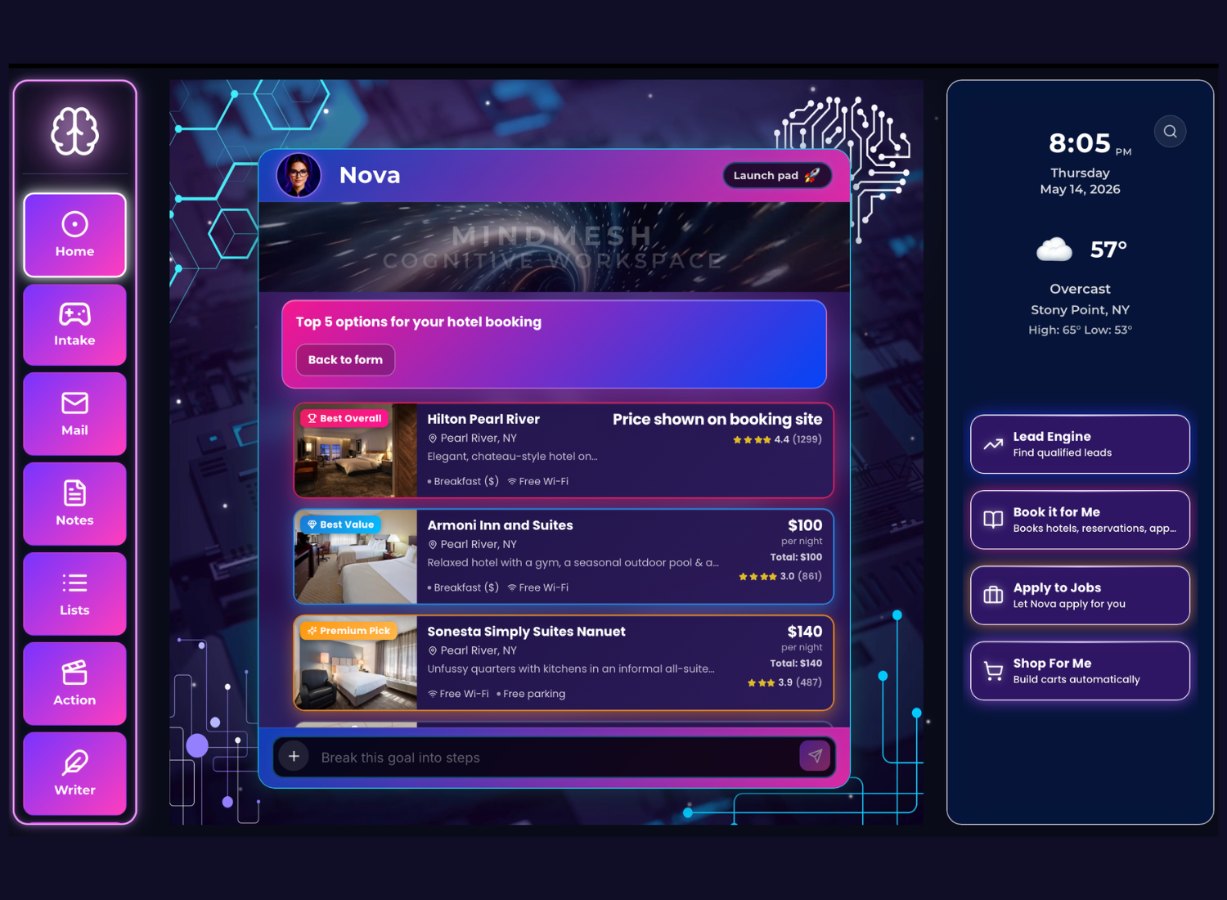
To escape this speed trap, we must shift our philosophy from tool accumulation to context centralization. The solution to digital fatigue is not to abandon AI, but to integrate it into a single, cohesive environment. By bringing our notes, tasks, and AI assistants into a unified cognitive workspace, we eliminate the friction of tool-hopping and create a sanctuary for deep focus.
When your workspace is unified, your tools adapt to your thoughts, rather than your thoughts adapting to your tools. You no longer need to worry about where a specific piece of information lives or which AI tool has the correct context. The system holds the background information, allowing you to move seamlessly from an unstructured brainstorm to an actionable task list without losing your creative train of thought.
This shift changes our relationship with technology. Instead of managing a chaotic ecosystem of apps, we interact with a single, calm interface that preserves our mental momentum. The relief of working in such an environment is immediate. The constant background anxiety of "What did I forget?" or "Where did I save that prompt?" evaporates, replaced by the quiet clarity required for high-level execution.
AI Memory as an External Mind
The true power of centralizing your digital environment lies in the creation of an integrated AI memory. In a fragmented setup, every interaction with an AI tool is a cold start. You must write long, detailed prompts to explain who you are, what your project is, and what tone you want to achieve. You are constantly re-educating your tools, which is itself an exhausting form of cognitive labor.
When your context is centralized, however, your AI tools have access to a continuous stream of project history, personal notes, and strategic goals. The system develops an ongoing memory of your work. It understands the relationship between a rough note you took during a client call last week and the proposal you are drafting today.
This external mind does not replace human thought; it liberates it. When the system holds the organizational context, your brain is freed from the burden of information storage. You do not need to use your precious cognitive bandwidth to remember where you put a file or what the client's secondary objective was. You can use your mind for what it does best: synthesizing ideas, making lateral connections, and injecting genuine human creativity into your projects.
---
Designing Systems for Attention Protection
For founders, operators, and creators, building a sustainable personal operating system is no longer a luxury—it is a survival requirement for the future of work. The sheer volume of incoming information and the speed of AI-driven markets will quickly crush anyone relying on ad-hoc, fragmented systems.
To build a resilient system, we must design for attention protection rather than raw throughput. This requires a deliberate shift in our daily workflows:
1. Consolidate Your Capture Mechanisms
Ensure that every idea, task, and meeting note lands in a single inbox. Do not allow your thoughts to be scattered across chat saved messages, physical notebooks, and draft emails. When you have a single point of entry, you eliminate the mental friction of deciding where to store information.
2. Define Your Context Boundaries
Group your work by project or cognitive state, not by tool. When you are working on product strategy, all relevant notes, tasks, and AI resources should be visible in one view, shielding you from the distractions of unrelated projects. This containment prevents your attention from drifting to other tasks.
3. Minimize Active Tool Interaction
Choose tools that work quietly in the background. The best systems are those that require the least amount of maintenance and configuration, keeping the focus entirely on your actual output. If you spend more time organizing your productivity system than doing actual work, your system has failed.
Ultimately, the goal of any personal system should be to reduce the friction between an idea and its execution. By designing workflows that prioritize mental ease, we can transition from a state of reactive firefighting to one of proactive creation.
---
Reclaiming the Human Core of Creative Leverage
We must remember that technology is a leverage multiplier, but the lever itself is human creativity. An AI can generate ten variations of a landing page in seconds, but it cannot understand the deep, human empathy required to connect with a struggling customer. It can analyze financial data at lightning speed, but it cannot summon the courage to pivot a company's strategy in the face of uncertainty.
When we drown in digital noise and coordination overhead, we sacrifice the very qualities that make our work valuable: our intuition, our empathy, and our unique perspective. We become bottlenecks in our own automated systems, spending our energy on mechanical tasks rather than creative breakthroughs.
Reclaiming your momentum is an act of professional self-preservation. It is a decision to stop worshiping the false god of raw speed and start valuing the depth of your focus. By clearing the digital clutter and centralizing our cognitive context, we can finally quiet the noise, step off the high-speed hamster wheel, and return to the quiet, satisfying work of building things that matter.
"We do not need more tools to accelerate our output; we need a single space to anchor our minds, because the ultimate bottleneck to creation is never the speed of our technology, but the clarity of our attention."